

What Is CRM Integration?
CRM integration is the process of connecting your CRM system with your other software applications to have consistent and accurate data across platforms. This integration enables different departments to easily access and share the same customer information.
Hence, this seamless coordination and collaboration help you become highly efficient.
An integrated CRM system is different from a standalone CRM, this is because an integrated CRM communicates with other tools, such as email marketing platforms, e-commerce systems, and customer support software.
For example, integrating your CRM with an email marketing tool lets your sales teams keep an eye on your customer interactions and campaign responses directly from the CRM.
Here are a few examples of CRM Integrations:
- ERP Systems: Integrating with Enterprise Resource Planning systems will help you align your sales data with inventory and all the financial information.
- Marketing Platforms: Connecting with tools like Mailchimp or HubSpot helps you carry out targeted marketing campaigns based on CRM data.
- E-commerce Platforms: CRM integration with platforms like Shopify gives you real-time updates about customer purchases and preferences.
By integrating your CRM system with these tools, you can have a unified platform that improves your data accuracy, gives better customer insights, and optimizes your business processes.
Why CRM Integration Matters
CRM integration is important for businesses because it provides a smooth customer experience and also enhances their operational efficiency. By integrating your CRM with other systems, you can achieve the following:
- Unified Customer Data: By centralizing all customer information, you can guarantee that all departments have access to the same data. This also reduces errors and inconsistencies and makes operations efficient.
- Increased Productivity: Automating data entry and updates across systems saves time and reduces manual work, and also cuts down errors that are caused by human intervention.
- Personalized Experience: By having access to detailed customer data, you can devise personalized marketing campaigns and support strategies for every customer. This can give a boost to customer satisfaction and retention.
- Smarter Decision-Making: Consolidated data can help you derive better insights. Thus helping you in strategic planning and demand forecasting.
According to a report by Grand View Research, the global customer relationship management market size was valued at USD 73.40 billion in 2024 and is projected to reach USD 163.16 billion by 2030, growing at a CAGR of 14.6% from 2025 to 2030.
These huge figures highlight the increasing reliance and popularity of integrated systems for business success.
What Are the Common Types of CRM Integrations?
CRM integrations can be categorized according to the functions they perform:
- Email & Calendar Tools:
Integrating CRM scheduling tools such as Outlook or Google Calendar helps in scheduling meetings and tracking all the communication.
- Marketing Platforms:
Connecting with tools like Mailchimp or HubSpot helps you execute automated marketing campaigns and track leads.
- ERP/Accounting Systems:
CRM Integration with systems like QuickBooks or SAP matches your financial data with the corresponding customer information.
- E-commerce Systems:
Linking with platforms like Shopify or Magento provides insights about the purchasing behaviour of customers, helping you plan better.
- Customer Support Tools:
Connecting with customer support tools makes sure that your support teams have access to the customer history and all their interactions.
- Custom/Internal Apps:
Integrating with proprietary applications customizes your CRM to meet your unique business needs.
If you implement these integrations, then your businesses can create a highly cohesive ecosystem that boosts customer engagement and operational efficiency.
How Does CRM Integration Work?
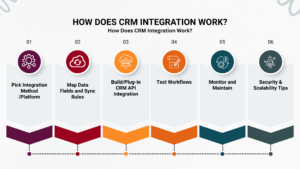 Integrating a CRM system involves several steps:
- Pick Integration Method/Platform:
There are multiple integration methods; you must choose between APIs, middleware, or no-code tools. This decision is based on your technical capabilities and requirements.
- Map Data Fields and Sync Rules:
Define how data will flow between systems, and make sure that there is consistency and accuracy.
- Build/Plug-in CRM API Integration:
Develop or use existing connectors to establish communication between the CRM and other applications.
- Test Workflows:
Carry out thorough testing to identify and resolve any issues before proceeding with full deployment.
- Monitor and Maintain:
Regularly check the integration for any discrepancies and update as per requirement.
- Security & Scalability Tips:
Implement solid security measures like encryption and plan for future scalability to accommodate business growth.
CRM Integration Tools & Platforms
Several tools and platforms are there to facilitate CRM integration. Here is a quick comparison:
| Platform | Type | Best for | Pricing |
| Burq iPaaS | iPaaS | Scalable CRM, ERP, eCommerce, and custom app integrations | Custom and usage-based pricing |
| Workato | iPaaS | Complex integrations | Varies |
| Zapier | No-code | Simple, quick setups | Subscription-based |
| MuleSoft | Middleware | Enterprise-level integrations | Custom pricing |
| Jitterbit | API Integration | Data transformation needs | Tiered pricing |
These platforms provide multiple features that can cater to the needs of different business sizes and integration complexities.
Moreover, CRM integration services are available for businesses that want expert assistance, with costs depending on the project’s scope and requirements.
Salesforce CRM Integration – A Closer Look
We know that Salesforce is a cloud-based software company that provides customer relationship management (CRM) services.
It gives a powerful ecosystem for CRM integration, with the help of tools such as MuleSoft and native connectors that enable seamless data exchange.
These tools facilitate integration with marketing clouds, communication platforms like Slack, and ERP systems, enhancing the CRM’s functionality.
For example, integrating Salesforce with a marketing cloud enables automated campaign management; on the other hand, connecting with ERP systems makes sure that data between sales and finances is aligned.
By utilizing Salesforce’s integration capabilities, businesses can create a connected platform that enhances customer engagement and operational efficiency.
Common CRM Integration Challenges & Best Practices
While CRM integration has many benefits, it also poses multiple challenges:
| Challenges | Best Practices |
| Data mismatch | Clean and standardize data before integration |
| Privacy/security issues | Implement robust security protocols |
| Sync failures | Regularly monitor and test integrations |
| User adoption | Provide comprehensive training and support |
If you address these challenges proactively, then you can move towards a smoother integration process and maximize the benefits of a unified CRM system.
Peek Into the Future:
There are many factors leading to the market growth these days. These include ongoing trends like hyper-personalization of customer service, automation, and artificial intelligence (AI), and the use of reliable social media customer service.
These future-forward trends can help lower costs, improve customer satisfaction, speed up response times, and boost the adoption of CRM platforms across industries.
Conclusion
CRM integration is a solid move that can have a short-term and long-term impact on your business. It gives you higher visibility of your customer insights, streamlines your operations, and leads to massive cost savings.
By connecting your CRM with other business tools, you create a highly interconnected system that supports informed decision-making and better customer experiences.
Also, by understanding and implementing CRM integration, you can improve your business operations, customer relationships, and drive growth.
If you are thinking of CRM integration, then start by assessing your existing systems and identifying areas for improvement.
Powerful integration platforms such as BURQ iPaaS can help you with this process by providing you with a scalable and secure integration solution tailored to your unique business needs.
FAQs about CRM Integration
What does CRM integration mean?
CRM integration means connecting your CRM system with your other business applications to achieve seamless flow of data and have consistent customer information across all platforms.
What is the difference between CRM and integrated CRM?
A standalone CRM operates in isolation, but an integrated CRM communicates with other systems and then provides a complete 360-degree view of all customer interactions and data.
How do I integrate CRM with other tools?
Integration can be achieved through APIs, middleware, or low-code or no-code platforms. It depends on your technical expertise and business requirements.
What are the top CRM integration platforms?
Popular platforms include Burq iPaaS, Workato, Zapier, MuleSoft, and Jitterbit. Each offers unique features that cater to different integration needs.
Is CRM API integration better than third-party tools?
CRM API integration offers customization and control but also requires technical expertise, while third-party tools provide user-friendly interfaces for quicker setups.