

What is SaaS Integration?
In simple words, saas integration connects your different software-as-a-service applications so that they can share data and work as a cohesive system. These connections are typically created with the help of APIs, webhooks, middleware, or dedicated integrated platforms such as an iPaaS.
Here are the two types of saas integrations that you will usually deal with:
- Internal integrations:
These connect systems within your organization, such as syncing your CRM with marketing automation, or linking your inventory application with your accounting software.
- Customer/product integrations:
These enable your own SaaS product to connect with external platforms that your customers use (such as Slack, Salesforce, or NetSuite). These are important if you are a SaaS provider who wants to boost product retention.
But regardless of whether you are syncing two tools or more, the goal is the same, that is to have a smooth flow of data and help your teams, tools, and users collaborate seamlessly.
Why It Matters
When apps fail to communicate with each other, your teams have to act as the messengers. Which means more manual entry, hence more human errors, and a slower rate of execution.
But when you implement saas integration properly, things change fast.
You eliminate data silos, reduce redundant work, and unlock real-time visibility across the business. For your customers, it means smoother onboarding, fewer support tickets, and integrations with the tools they already use.
In competitive industries, saas application integration isn’t just a tech requirement—it’s a strategic differentiator. It impacts everything from sales and churn to customer satisfaction and long-term retention.
Benefits of SaaS Integration
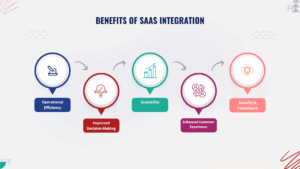 The secret behind the success of leading businesses is that they don’t just use SaaS, but rather, they build integrated SaaS ecosystems. Why? Because that is how they gain the real benefits of SaaS.
Here is how saas integration platforms deliver value across your entire business:
Operational Efficiency
When your apps communicate with each other, the need for repetitive data entry is eliminated. Whether it is syncing leads between marketing and CRM, or updating orders between eCommerce and fulfillment, you get smoother workflows and fewer errors.
When there is real-time saas data integration, your teams do not have to double-check spreadsheets or check numbers again and again. They do not waste time on useless tasks anymore..
Improved Decision-Making
Disconnected systems = disconnected data. And in this scenario, it becomes hard to take strategic decisions.
Integrated SaaS software pulls together insights from across all the departments, such as marketing, sales, support, and finance, and provides you with a complete picture. When business leaders have access to reliable and consistent data, they can make smarter and quicker decisions.
Scalability
As your business grows, will your tech stack be able to keep up with it?
This is where you see the beauty of integration as a service, that it scales with business. You can add new tools, automate more workflows, and plug into partner ecosystems without rebuilding everything from scratch. You just have to add on.
You can gain this powerful flexibility when you use a modern saas integration platform, because it acts as a central hub for your entire stack.
Enhanced Customer Experience
Customers are at the centre of every business because without them, businesses cannot exist. Therefore, it is important that you have fast response times, provide personalized interactions, and there are no dropped handoffs between support, sales, and billing.
You can only provide them this kind of experience these days through integrated systems. By connecting customer-facing tools, you reduce confusion, close tickets faster, and have consistency at every touchpoint.
Security & Compliance
Saas application integration also gives you control over your data. The risk of data leaks or compliance failures is lowered owing to centralized governance, standardized authentication, and visibility into data flows.
Using the right saas integration software also means that your security teams are not stranded in a tangled mess of APIs; in fact, they manage integrations through a unified and secure layer.
Core Problems & Pain Points
But let us face the elephant in the room, saas integrations are not always easy. And if you have tried building your own, you must be aware of the challenges.
Here are some of the most common pain points businesses face:
Data Silos & Manual Overhead
Your teams strive hard to fill the gaps when tools do not connect. This means copying data manually between systems, building custom exports, or working with outdated information.
This is very slow, error-prone, and drains the productivity of your team. As time passes, these silos make it impossible to get a clear view of all your business operations.
Integration Backlogs & Engineering Drain
However, it is expensive to build custom in-house integrations. Your development team ends up writing point-to-point connections, patching them every time APIs change, and struggling with fixes when things break.
This results in a never-ending backlog, and there are fewer resources for building actual product features.
Maintenance & Technical Debt
Even if you successfully build a few integrations, it is almost impossible for them to scale easily with you. As time passes, your team is left maintaining broken connections, untangling version mismatches, and chasing down third-party updates.
These technical issues grow quietly but significantly, slowing innovation and hurting the reliability of your system.
Risk Management
Then there is risk, as every integration adds another layer of exposure. Without centralized visibility, you can not monitor data flows or deploy access controls.
If you are functioning in a highly regulated industry, then open APIs, inconsistent auth protocols, and a lack of governance open the door to security risks and compliance issues.
So, yes, why saas integration is hard is not a mystery; it is solvable with the right approach.
Evaluate Integration Architectures
All integration models are not equal when it comes to implementation. Choosing the right architecture depends on your scale, complexity, and business goals.
Here is a quick look for you:
Model | Pros | Cons |
Native SaaS Integration | Low cost, often supported by vendors | Limited functionality, can’t customize |
Point-to-Point | Fully customizable for specific use cases | High maintenance, breaks easily as tools evolve |
iPaaS / ESB | Scalable, reusable components, centralized view | Requires technical expertise, vendor lock-in risk |
Embedded iPaaS | Low-code, embeddable in your own SaaS product | Depends on the tool capabilities and integration depth |
Modern tools like BURQ iPaaS offer scalable options and come with prebuilt saas connectors. They help you gain flexibility and control, without overloading your development team.
Strategies for Successful SaaS Integration
Now that you know what works well and what does not, let us see how to build a saas integration strategy that scales easily with your business.
Choose the Right Integration Model
Not all connections need a full platform. You can start by mapping your use cases and selecting the model that suits your scale and is possible with your resources. Whether it is native integrations, middleware, or a dedicated saas integration platform like BURQ iPaaS.
If you are building your own SaaS product, then you can consider embedded iPaaS to speed up time-to-market and support more customer integrations.
Best Practices to Drive Success
- Use APIs wherever possible. The modern REST APIs are cleaner, faster, and easier to maintain.
- Use real-time webhooks to avoid polling.
- Abstract your API layer so you can swap vendors without rewriting integrations.
- Stick to standardized protocols like OAuth2, OpenAPI, and JSON.
If you follow these best practices, then you can reduce tech debt and also future-proof your stack.
Tool Selection Framework
Every business is different, and hence not every tool is right for every business. So when you are selecting a saas integration software, ask these questions:
- Does it support your current and future apps?
- Can non-dev teams use it, or does it need extensive engineering support?
- What compliance standards does it follow?
- How well does it align with your business objectives?
Powerful tools like BURQ iPaaS provide low-code interfaces, strong governance, and scalable performance; hence, they are a great fit for growing businesses.
Measurement and Optimization
You simply cannot manage what you do not measure.
After your integrations are live, track key metrics like the following:
- Total cost of ownership (TCO)
- Integration velocity (how fast you can go from idea to live)
- SLA adherence and uptime
- End-user satisfaction (both internal and external)
If your integrations are not driving business outcomes, it is time to change your approach.
Conclusion
Although it might seem to you that Saas integration is all about getting your tools to talk, in reality, it is about building a business that moves faster, works smarter, and delivers more value at every level, and in the long run.
If it is done right, it jump-starts growth. You reduce overhead, gain agility, and offer your customers a smooth experience.
So, where can you go from here?
Here is a simple way forward for you:
- Map out your current SaaS stack and key stakeholders.
- Identify your use cases that are high-impact. Always start with the biggest pain points.
- Choose the right architecture that fits your scale and technical skills.
- Start with launching a pilot first, track success, and scale across the organization.
You can gain numerous benefits if you treat integration as a service, not an afterthought, because they don’t just connect tools, they build connected businesses.
So, if you are looking for a powerful and all-encompassing platform to help you along your integration journey, then you must try BURQ iPaaS. It has built-in saas connectors, flexible deployment options, and a low-code, no-code interface, which is built for modern integration challenges.
Whether you want to integrate legacy systems or power saas api integrations, BURQ iPaaS is both agile and reliable.
The future of business is connected. And saas integration can get you there.