

Key Takeaways
- Three dominant ERP integration methods exist: Direct API integration, EDI, and middleware, each suited to different scenarios and complexity levels.
- API integration is fast to start but hard to maintain at scale: It works well for two-system connections but becomes a cost center once you add a third, fourth, or fifth system.
- EDI is the standard for supply chain and retail compliance: Trading partners in manufacturing, retail, and logistics often mandate it, so opting out is rarely an option.
- Middleware is the right architecture for multi-system Dynamics 365 environments: It centralizes integration logic, eliminates point-to-point sprawl, and gives your team one place to monitor and troubleshoot.
- Choosing the right middleware platform matters: Dynamics 365-specific iPaaS tools reduce setup time and ongoing overhead compared to general-purpose alternatives.
Introduction
Have you ever inherited a Dynamics 365 environment where someone had already “handled” the integrations? Chances are you already know what that looks like: a patchwork of custom API scripts connecting ERP to ecommerce, a separate EDI setup managed by a third party, a few Power Automate flows that break every time a field changes, and no central place to see what is flowing where.
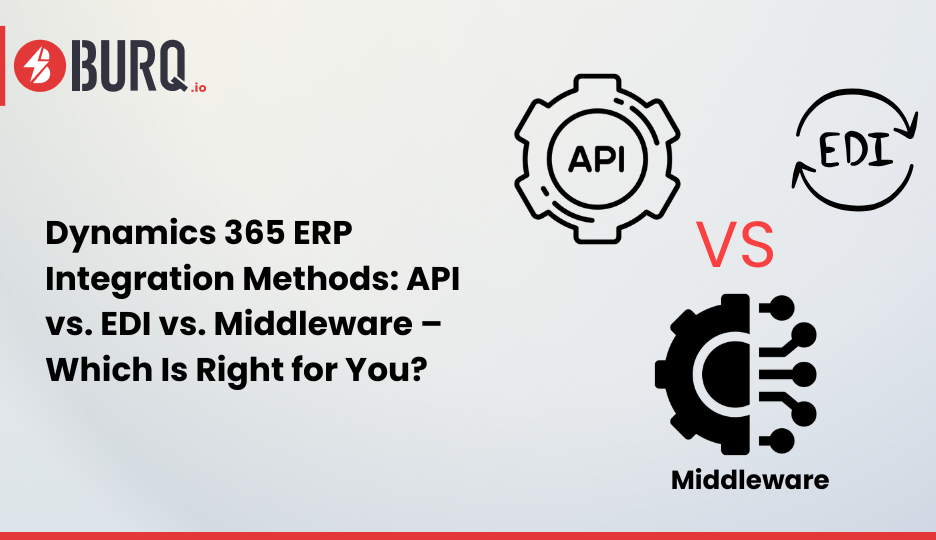
That is what happens when integration decisions get made system by system, without an architecture decision upfront. The three core ERP integration methods (direct API integration, EDI, and middleware) each have a clear use case. The question is not which one is technically possible. The question is which one fits your Dynamics 365 environment, your trading partner requirements, and your team’s capacity to maintain what gets built.
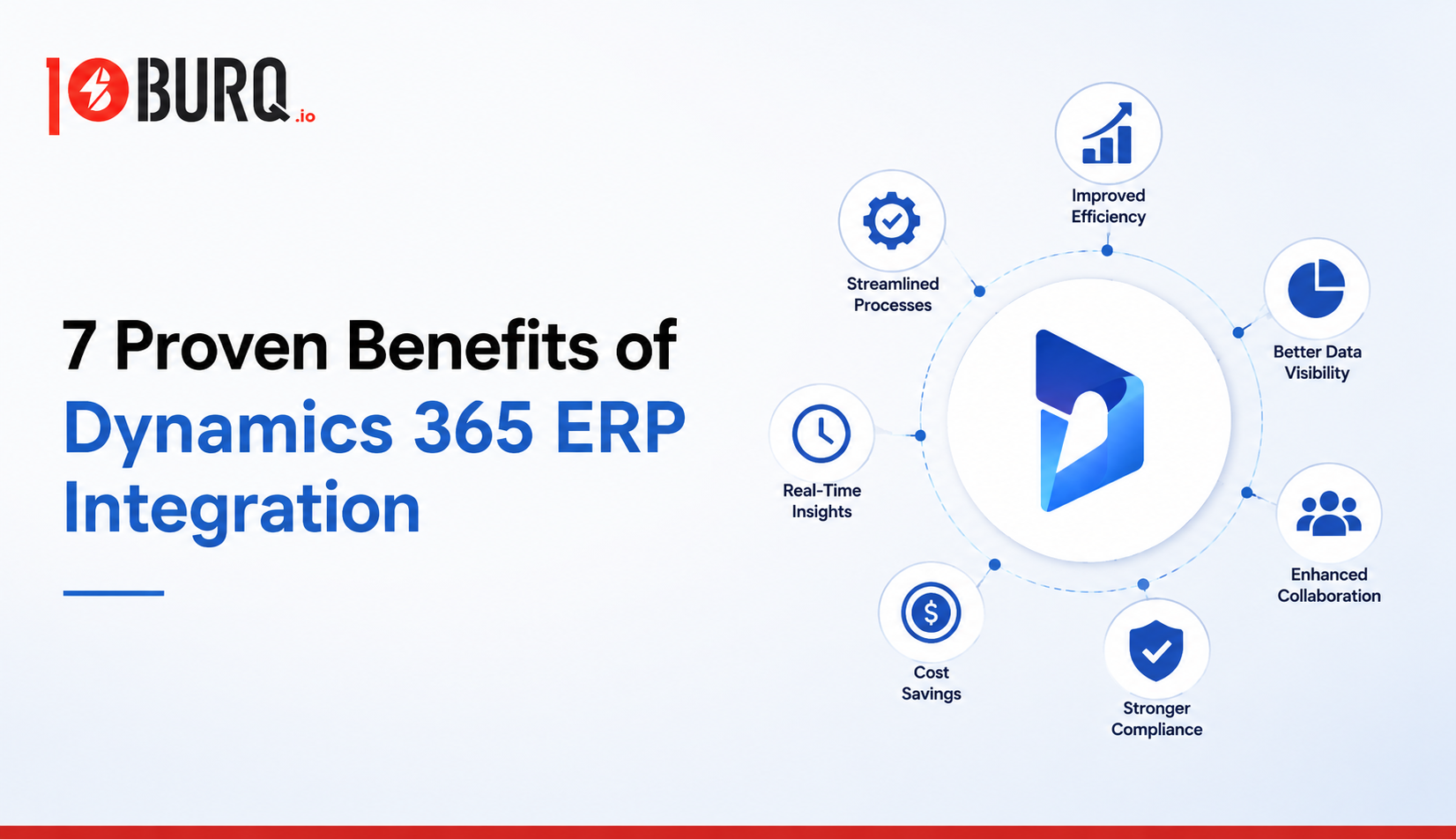
This post breaks down each method, compares them honestly, and explains when middleware should be your default ERP integration architecture for Dynamics 365. If you are still weighing whether integration is worth the investment at all, the business case for Dynamics 365 ERP integration is worth reading first.
What Are the Main ERP Integration Methods?
Before comparing approaches, it helps to understand what each method actually does.
Direct API integration connects two systems by having one call the other’s API directly. Your Dynamics 365 instance exposes REST or OData endpoints; your ecommerce platform, CRM, or warehouse system calls those endpoints to push or pull data. No intermediary involved. Microsoft publishes full API documentation for Business Central that covers available endpoints, authentication, and entity schemas.
EDI (Electronic Data Interchange) is a structured message format used to exchange standardized business documents (purchase orders, invoices, advance shipping notices) between trading partners. EDI can run over AS2, SFTP, or VAN (Value-Added Network) connections. The X12 EDI transaction set standards define the document formats most North American retailers and manufacturers require.
Middleware (iPaaS) sits between your systems and manages the flow of data between them. Instead of System A talking directly to System B, both systems talk to the middleware layer, which handles transformation, routing, error handling, and retry logic centrally.
Direct API Integration: Fast to Start, Hard to Scale
Direct API integration is the starting point for most Dynamics 365 environments. It is fast, developer-friendly, and works well in the right conditions. The challenge is that those conditions are narrower than most teams assume.
How It Works With Dynamics 365
Dynamics 365 Business Central and Dynamics 365 Finance and Supply Chain Management both expose robust APIs. Business Central uses OData v4 endpoints; Finance and Supply Chain Management uses REST APIs with data entities. A developer can connect Shopify, Salesforce, or a 3PL portal to Dynamics 365 via these APIs in a matter of days.
Where API Integration Makes Sense
Direct API integration is the right call when you have exactly two systems that need to communicate, the connection is relatively simple, and you have an internal developer who owns the ongoing maintenance. A good example is syncing a single Shopify store’s orders into Dynamics 365 Business Central for a business with no other connected systems. Clean, contained, low overhead.
The Scaling Problem
The moment you add a third system, direct API integration becomes a liability. Every new system means new point-to-point connections. With five systems, you can have up to ten separate integrations to build, document, monitor, and debug. When Dynamics 365 releases a platform update that changes an API endpoint, and it does, every one of those connections needs to be reviewed and potentially patched.
This is the “spaghetti integration” problem that most mid-market Dynamics 365 environments run into between year two and year three of their ERP deployment. For a fuller picture of how these architecture decisions compound over time, the Dynamics 365 ERP integration guide covers the common failure patterns in detail.
EDI Integration: Non-Negotiable for Supply Chain and Retail
Unlike API integration, EDI is rarely a choice you get to make on your own terms. Whether you need it is almost always determined by your trading partners, not your internal architecture preferences.
Why EDI Still Exists in 2025
EDI is not a legacy format that survived past its useful life. It is the language that large retailers, 3PLs, and manufacturers require their trading partners to speak. If you sell to Walmart, Target, or Amazon Vendor Central, or if you work with a major 3PL, you are likely contractually required to support EDI documents: the 850 Purchase Order, the 856 Advance Shipment Notice, the 810 Invoice, and others. You do not get to choose whether to support EDI in those environments. You choose how to support it.
EDI and Dynamics 365: The Integration Challenge
Dynamics 365 Business Central and Dynamics 365 Finance and Supply Chain Management do not have native EDI engines. EDI requires a VAN or AS2 connection, document mapping from EDI format to Dynamics 365 data structures, and acknowledgment handling: 997 functional acknowledgments and 855 order acknowledgments. That is a specialized capability set that most Dynamics 365 implementations need to source externally.
The traditional approach is to use a standalone EDI provider that translates EDI documents and drops flat files somewhere for Dynamics 365 to pick up. That architecture creates sync delays, error blind spots, and duplicate data management work that your team ends up absorbing quietly over time.
Where Middleware Fits the EDI Story
The better architecture routes EDI documents through your middleware layer, where they get translated, validated, and pushed into Dynamics 365 in real time alongside your other integrations. That gives your operations team one monitoring interface for everything rather than two separate systems with separate error queues. If you are evaluating how EDI fits into a broader Dynamics 365 integration strategy, the Burq ERP solution overview shows how EDI and API-based connectors can run through the same layer.
Middleware: The Right ERP Integration Architecture for Multi-System Dynamics 365
Once you move past two or three connected systems, the architecture question changes. Direct API connections stop being a viable long-term approach, and middleware becomes the more practical default.
What Middleware Actually Does
Middleware, also called iPaaS (Integration Platform as a Service), is a layer that sits between your systems and owns the integration logic. It handles:
- Data transformation: Converting a Shopify order payload into the format Dynamics 365 Business Central expects, including field mapping, currency conversion, and tax logic
- Routing: Sending the right data to the right system based on business rules. For example, orders above a certain value route to a manual approval queue while others auto-create in ERP
- Error handling and retry: If Dynamics 365 is temporarily unavailable, middleware queues the message and retries rather than dropping it or throwing an unhandled exception
- Monitoring and alerting: One dashboard showing every integration, every error, and every volume metric across your connected systems
According to Gartner’s research on integration platform as a service, iPaaS adoption has grown consistently as organizations move away from point-to-point integration toward centralized, managed architectures, particularly in mid-market ERP deployments.
Why Middleware Is the Right Default for Dynamics 365 Environments
Most Dynamics 365 implementations do not stay simple. A Business Central deployment that starts with one Shopify store tends to grow into a multi-channel environment with a 3PL integration, an EDI requirement from a new retail partner, a CRM sync, and a custom reporting layer. Each of those additions, when handled with direct API connections, adds complexity that compounds rather than stacks.
Middleware keeps that complexity linear. Adding a new system means adding one new connector to the middleware layer, not rebuilding or auditing all existing connections. The other major advantage is ownership. When integration logic lives in custom API code, it belongs to whoever wrote it, and when that developer leaves, the logic leaves with them. Middleware externalizes that logic into a configurable, documented layer that your team can inspect and modify without touching code. To see how this plays out across different Dynamics 365 deployment types, the Burq ERP solution overview walks through the connector architecture and supported scenarios.
Choosing a Middleware Platform for Dynamics 365
Not all middleware platforms are created equal, some will work better than others. Specifically, if your goal is to implment one for Dyanmics 365. It’s helpful to have one that plays well with the Microsoft ecosystem.
General iPaaS vs. Dynamics-Specific Middleware
General-purpose middleware platforms like MuleSoft, Boomi, and Workato are enterprise-grade tools built for large IT teams with dedicated integration engineers. None of them have Dynamics 365-specific logic pre-built, so you are writing the field mappings, the Business Central OData queries, and the Finance and Supply Chain Management batch job configurations yourself. That is months of setup before any data actually flows.
Dynamics 365-specific middleware platforms reduce that overhead considerably. Pre-built connectors for Business Central and Finance and Supply Chain Management mean the data structures and authentication flows are already handled. The practical difference between a general iPaaS and a Dynamics-specific one can be the difference between a weeks-long configuration project and a days-long one. For a comparison of how different integration approaches affect total implementation cost, the Dynamics 365 ERP integration guide breaks this down with real deployment scenarios.
What to Evaluate in a Middleware Platform
When evaluating middleware for a Dynamics 365 environment, the questions that matter most are:
- Does it have native connectors for the Dynamics 365 products you run: Business Central, Finance and Supply Chain Management, or both?
- Can it handle EDI alongside API-based integrations in the same layer, or does EDI require a separate tool?
- What does error visibility look like: per-connection logs or a centralized dashboard?
- How is pricing structured: per transaction, per connector, or flat fee?
The pricing question matters more than it appears. Usage-based pricing works when transaction volumes are predictable. For businesses with seasonal spikes in retail, manufacturing, or distribution, flat-fee pricing removes the cost uncertainty that usage-based models introduce as order volumes scale.
API vs. EDI vs. Middleware: A Direct Comparison
| Direct API | EDI | Middleware (iPaaS) | |
|---|---|---|---|
| Setup time | Days to weeks | Weeks to months | Days (with pre-built connectors) |
| Maintenance burden | High (per connection) | Medium (standards-based) | Low (centralized) |
| Scales to 5+ systems? | No | N/A | Yes |
| Handles EDI? | No | Yes | Yes (via middleware layer) |
| Error visibility | Per-system | Per-connection | Centralized dashboard |
| Right for Dynamics 365? | Simple 2-system scenarios | Trading partner compliance | Multi-system environments |
| Typical cost model | Developer time | VAN/provider fees | Per-connector or flat fee |
How to Choose the Right ERP Integration Method for Your Dynamics 365 Environment
Use direct API integration if you have one or two systems to connect, a developer who owns maintenance, and no expectation of adding more connected systems in the next 18 months.
For EDI, use it when your trading partners require it, which means having an EDI-capable layer that plugs into your broader integration architecture rather than sitting separately.
Use middleware as your default ERP integration architecture if you run three or more connected systems, if you are planning to add systems, if your team does not want to maintain custom integration code, or if you want one place to monitor and extend your Dynamics 365 integrations over time.
The organizations that get this decision right upfront avoid a painful re-architecture project 18 to 24 months into their ERP deployment. The ones that default to direct API connections for everything tend to end up at the same place eventually; they just pay more to get there.
Getting the architecture right is straightforward once you understand the tradeoffs. The harder part is choosing a middleware platform that does not require a six-month implementation before data starts flowing. For Dynamics 365 environments specifically, that means looking for pre-built connectors, native EDI support, and a pricing model that does not work against you as order volumes grow. Burq iPaaS is built for exactly that, with flat-fee pricing and connectors for 200+ platforms alongside native support for Business Central and Dynamics 365 Finance and Supply Chain Management. Talk to a Burq integration specialist to see whether it fits your environment.
Frequently Asked Questions
What is the difference between API integration and middleware for Dynamics 365? Direct API integration connects two systems to each other without an intermediary. Middleware sits between all your systems and manages data flow, transformation, and error handling centrally. For Dynamics 365 environments with multiple connected systems, middleware is the more maintainable architecture over time.
Does Dynamics 365 support EDI natively? No. Dynamics 365 Business Central and Dynamics 365 Finance and Supply Chain Management do not have native EDI engines. EDI capability requires either a standalone EDI provider or a middleware platform that includes EDI connectivity alongside your other integrations.
What is ERP integration middleware architecture? ERP integration middleware architecture is a design pattern where a central middleware layer manages all data flows between your ERP system and connected applications, rather than each system connecting directly to each other. This approach reduces complexity, improves error visibility, and makes it easier to add or change integrations over time.
Can a single middleware platform handle both API and EDI integrations for Dynamics 365? Yes, and this is one of the main advantages of the middleware approach. Platforms with EDI support can handle both REST API-based integrations (Shopify, Salesforce, Magento, WooCommerce) and EDI-based integrations (850, 856, 810, and other standard documents) through the same layer, giving your team one place to monitor and manage all Dynamics 365 data flows.
When should you use direct API integration instead of middleware? Direct API integration is appropriate when you have exactly two systems to connect, the integration logic is simple, and you have a developer who can own ongoing maintenance. As soon as you add a third system or need error handling, transformation logic, or centralized monitoring, middleware becomes the better choice.