

You know that sinking feeling when an email lands: “Our ERP API just changed again”? If you’ve ever been on the receiving end of these surprise maintenance requests, then you might be frustrated. What once seemed like a sleek setup, connecting two systems, is now a layer of brittle links that keep breaking, costing you time and money.
This blog dives into why BURQ iPaaS is the antidote to custom, point-to-point integrations. You’ll see how it simplifies integration, slashes complexity, and gives your team relief from not waking at 3 a.m. to fix a broken script.
What’s Wrong with Point‑to‑Point Integration?
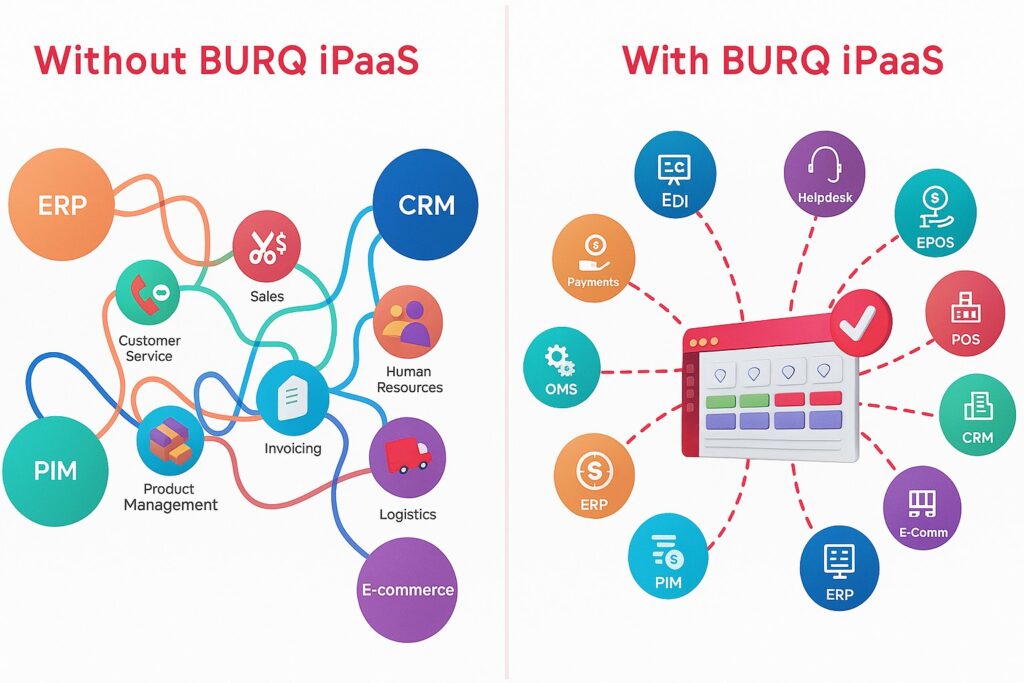
Picture an entangled IT ecosystem, looking like a spiderweb. That’s your tech stack with point-to-point integrations. Imagine this:
- If you have five applications connected, you’re already managing up to ten individual integrations.
- Add another system, and you’re likely creating five more dependencies to build and maintain.
- And when one API changes, whether it’s a new field or version, you’re back in the codebase, burning dev hours just to fix what used to work.
According to Forrester, companies burn around 30–40% of their days on integration maintenance when dealing with point-to-point setups. Moreover, 85% of projects fail because companies struggle to properly integrate their systems.
Hence, onboarding new tools like ERP, CRM, or marketing platforms will become painful if you don’t consider integrating them effectively, or only rely on point-to-point integration for system connectivity.
Why BURQ iPaaS Is the Better Alternative?
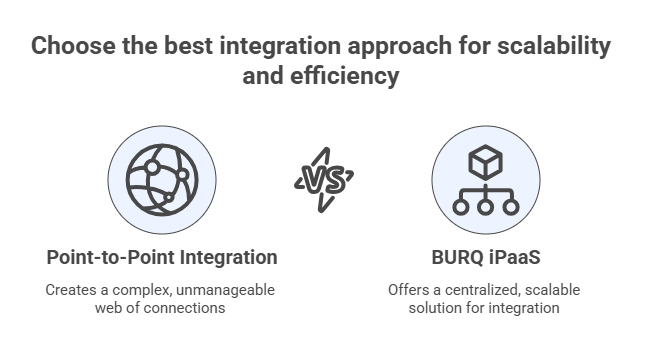
BURQ helps you replace point-to-point with iPaaS, transforming those entangled systems into a clean, manageable IT hub.
Think of it like this:
- Instead of managing 20 separate app-to-app connections, each of your system applications connects directly to BURQ.
- Need to connect Shopify or Dynamics CRM? Select the connector and configure it; no custom coding required.
- With centralized control, you get a single dashboard to monitor and manage all integrations, with clear visibility into issues when they occur.
Unlike point-to-point integration, where every new system adds more complexity and risk, BURQ offers a structured, scalable approach. You’re not rebuilding the same logic repeatedly or dealing with fragile, one-off connections that break whenever an API changes. Instead, BURQ iPaaS provides reusable components, consistent data flows, and built-in monitoring. Hence, integrations stay reliable even when your tech stack grows.
How BURQ IPaaS Works?
BURQ works in the following manner:
- Pre-built connectors: Shopify, Amazon, Microsoft Dynamics, Stripe, and more. BURQ offers you pre-built connectors to integrate your applications.
- Low-code workflow designer: Drag-and-drop field mappings, build business logic, add timings or triggers, all without scripting.
- API + EDI support: Got legacy systems that still speak ANSI X12 or EDIFACT? BURQ handles them alongside modern SaaS APIs.
- Intelligent monitoring: See failed transactions, rerun them, and get real‑time alerts.
- Analytics: Track latency, volume, error rates, and more to help optimize flows.
How can you benefit from BURQ IPaaS?
If you’ve ever had to make the call between fixing a broken integration or just manually sending a CSV again, you’ve lived through the frustration. Teams delay upgrades, avoid switching systems, or put off critical automation just because the integrations feel too fragile to mess with. One system change affects another, and suddenly, operations become chaotic to manage. BURQ cuts through that inertia by making integrations feel stable, safe, and predictable. If you opt for BURQ for system integration, then you can get the following benefits:
Efficiency
Every team has those invisible tasks that quietly eat up hours, downloading a report, rechecking data, and cleaning up after another sync fails. BURQ strips away those repetitive chores by automating the way your systems talk to each other. No more incomplete fixes or manual workarounds. When customer records stay updated, orders flow smoothly with BURQ, then teams get their work done efficiently.
Lower Costs
BURQ’s low-code approach cuts down on development time. But the real savings show up in the long run, where most companies quietly bleed money. Constant troubleshooting, patching broken workflows, and rewriting logic after every API change all add up in increasing operational cost. BURQ reduces that burden. Built-in error handling, version-aware connectors, and centralized monitoring mean your team spends less time fixing problems and more time building value. It’s not just about writing less code. It’s about avoiding the mess altogether.
Scalability
Growth usually means complexity. More tools, more data, more moving pieces. But with BURQ, scaling up doesn’t mean things get shaky. You can add new systems and channels without rewriting your setup from scratch. Whether it’s syncing orders, managing inventory, or integrating with a partner over EDI, BURQ helps you to scale your system faster.
Governance and Security
Security isn’t a feature, it’s a foundation. BURQ logs every action, controls who can access what, and encrypts data as it moves. That means fewer compliance headaches and more trust across your team. With BURQ, you’re not just making your IT ecosystem secure, but also gaining customers’ trust.
Real User Feedback: People Actually Like It
BURQ IPaaS consistently earns top marks on G2 with a 4.8/5 average rating, and the standout themes are clear:
Support & Partnership
“Great platform and outstanding professional team… I would recommend them to anyone interested in positive and hassle-free integrations.”
Users appreciate that BURQ isn’t just software; they see the team as an extension of their own, proactive, and reliable.
Ease of Integration & Customization
“We launched a full Shopify‑to‑ERP order flow in under 10 days, no devs involved.”
“Their organized approach and deep knowledge… quickly get our business challenges and come up with effective, creative solutions.”
These comments highlight how quickly teams can leverage BURQ pre-built connectors, with little to no code.
Reliability & Low Maintenance
“The BURQ platform for the past 5+ years has enabled us to focus on growing the business and less on the problems around integrations.”
Once BURQ is in place, it runs smoothly, letting teams concentrate on innovation instead of managing middleware.
BURQ vs. Custom Integrations
Let’s say you want to sync your warehouse system with your CRM to reflect live inventory updates. With custom point-to-point, you’re looping in devs to build that from scratch. It takes weeks, you have to manage versioning, and if your CRM updates its API mid-year? Back to square one. Now picture doing that in BURQ: Choose connectors, map your flow visually, test, and deploy. You’re not filing tickets, you’re solving problems. It’s not just faster. It’s less exhausting.
Let’s see how this shapes up:
| Aspect | Custom P2P Integrations | BURQ iPaaS |
| Time to Live | Weeks to months | Days or hours |
| Maintenance | Manual, prone to bugs | Proactive, auto-updated |
| Adding Features | Dev cycles + regression testing | Drag‑and‑drop + quick deploy |
| Error Handling | Basic log files, often ignored | Visual alerts, annotation, and replay |
| Scaling | Major refactors needed | Connect more apps with connectors |
| Costs (year 1) | High initial dev + ongoing overhead | Lower overall, with predictable pricing |
Who can use BURQ IPaaS?
BURQ is built for teams struggling to keep systems connected and synchronized. It’s a game-changer for:
- Mid-sized to enterprise companies are juggling more than five apps.
- Teams dealing with real-time synchronization or alarmingly manual data flows.
- Organizations stuck with EDI partners (distributors, 3PLs, B2B).
- Businesses in high-growth mode: new markets, new tools, new processes.
If your team is spending more time just moving data between systems instead of using it, and everything slows down when your one integration expert is away, it’s a sign that your current setup isn’t working and you’re ready for BURQ. iPaaS isn’t just about automating flows. It’s about creating a system your team can rely on, even if roles shift and businesses scale in unpredictable ways.
Getting Started with BURQ: A Roadmap
Nothing is challenging about onboarding BURQ. Here’s a manageable, human-paced rollout plan:
- Discovery: Identify all existing point-to-point integrations and recurring data tasks.
- Pilot Scope: Choose one process (e.g., syncing orders to fulfillment) for initial implementation.
- Workflow Design: Build the integration using Burq’s low-code designer.
- Testing: Run edge cases and validate with automated test runs.
- Deployment: Launch the integration and deprecate old scripts.
- Monitoring: Use built-in analytics to track and optimize performance.
- Scale: Replicate the model to integrate additional workflows efficiently.
Best Practices to Replace Point‑to‑Point Successfully
Here’s a shortlist for making iPaaS work well:
- Modular workflows: Avoid monolithic flows that are difficult to manage and troubleshoot. Instead, break logic into smaller, reusable workflow components that can be maintained independently and scaled across use cases.
- Low-Code Tool: BURQ’s intuitive interface enables operations and business users to design, manage, and update integrations without relying heavily on engineering resources. This decentralizes ownership and reduces bottlenecks in delivery
- Logging & alerts: Maintain strict governance through audit logging, role-based access control, and separation of duties. Credentials should be rotated periodically, and access should be limited to the minimum required for operational roles.
- Enforce Governance and Security Controls: Maintain strict governance through audit logging, role-based access control, and separation of duties. Credentials should be rotated periodically, and access should be limited to the minimum required for operational roles.
- Continuous Optimization: Establish a routine, such as quarterly reviews, to evaluate integration performance. Assess latency, error rates, system load, and workflow reuse opportunities. Use insights to refine existing workflows and scale integration coverage with new connectors as needed.
Final Thoughts
Replacing point-to-point with BURQ iPaaS turns an entangled IT ecosystem mess into a managed, visible, scalable, and reliable system. You get peace of mind, your team gets faster workflows, and your leadership gets cost predictability.
If you’ve ever been burned by brittle scripts or opaque integrations, BURQ won’t just be an upgrade; it’ll feel like a relief. And that’s worth acting on. Book a session to see the platform in action. Clean up your IT stack and move towards faster and reliable integration.
FAQs
Why do point-to-point integrations cause problems as companies grow?
Because every time you connect two systems directly, you’re creating a fragile link that needs manual upkeep. Add more tools, and you’re juggling more of these one-off connections—each prone to breaking when something changes. It’s fine at first, but over time it becomes a mess that’s hard to maintain and even harder to scale.
How is BURQ iPaaS different from traditional point-to-point setups?
Instead of building individual links between every pair of apps, BURQ acts like a central hub. You connect each system to BURQ once, and it handles the rest, making the whole process cleaner, easier to manage, and way more resilient when APIs change or workflows evolve.
What real benefits can teams expect from using BURQ?
The most immediate win is time, you stop spending hours fixing broken integrations. But beyond that, BURQ makes your workflows more reliable, helps teams move faster, and reduces your long-term costs. Plus, it’s designed to scale with you, so you’re not rebuilding everything when the business grows.
How quickly can we get up and running with BURQ?
Surprisingly fast. Many teams roll out their first integration in under two weeks, sometimes even faster.Thanks to BURQ’s low-code builder and ready-made connectors. No need for heavy dev work just to sync data between apps.
Is BURQ iPaaS a good fit for growing or changing businesses?
Yes, especially if you’re constantly adding tools, teams, or partners. BURQ is built to scale without breaking things. You can introduce new systems without redoing your whole integration setup, which is a big deal when you’re moving fast.
What kind of apps and systems does BURQ connect with?
BURQ supports a wide range, from newer platforms like Shopify and Stripe to older EDI-based systems. Whether it’s modern SaaS or legacy tools, BURQ makes it possible to connect them without building from scratch every time.