

Top Benefits of Shopify Integration for eCommerce Growth
Let us take a deeper look at the top benefits of Shopify integration, and how each one can have an impact on your business.
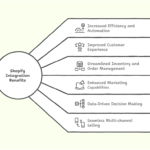
Increased Efficiency and Automation
Managing repetitive tasks is one of the biggest challenges in the eCommerce business. You have to spend long hours updating inventory, processing orders, and sending customer emails. But such monotonous tasks can easily be automated. Shopify integrations empower you to automate the majority of these processes save your time and eliminate chances of human error.
For example, stock levels are updated right away, and invoices are generated in real time when you integrate Shopify with your accounting or inventory software. Platforms like Mailchimp even let you automate order confirmations and promotional emails, and do customer follow-ups. As a result, there are fewer manual tasks, highly efficient processes, and more time for you to concentrate on growth-oriented long-term decisions.
Improved Customer Experience
Providing exceptional customer experience is the key to unlocking the full potential of your eCommerce business and building long-term customer loyalty. Shopify integrations can enrich and improve every step of the customer journey, from browsing to checkout and much more.
For example, integrating live chat tools with your Shopify store lets you provide real-time assistance to shoppers. If a customer has a query about a product or shipping, they do not need to send and wait for an email response, rather they can get immediate answers which results in higher conversion rates.
Moreover, Shopify app integrations with personalized marketing tools let you send personalized recommendations according to a customer’s purchase history. This lets you deeply engage customers, and increases the probability of repeat business.
Streamlined Inventory and Order Management
Maintaining the ideal inventory levels and managing orders is a complicated task, especially if you sell on multiple channels. With the help of Shopify integration, you can synchronize your inventory in real-time across all your sales channels, including your online store, social media platforms, and marketplaces like Amazon.
Integrating inventory management tools guarantees that stock levels are up-to-date and issues such as overselling or stockouts can be prevented proactively. Likewise, when you integrate Shopify with order management software, orders are automatically processed and tracked. This minimizes the chance of mistakes and speeds up the order fulfillment process.
By syncing inventory and orders, Shopify integration makes it a breeze to manage your operations and keep your customers satisfied with fast and accurate deliveries.
Enhanced Marketing Capabilities
Effective and impactful marketing is essential to stand out in the highly competitive eCommerce landscape. Shopify integrates with multiple marketing tools that can help you reach your target audience and boost sales.
You can integrate Shopify with social media platforms like Facebook to sell directly using your social media profile. These integrations let you make your products visible to a broader audience and engage with potential customers where they spend a lot of their time.
Moreover, Shopify’s integration with email marketing tools lets you run automated campaigns. Tools like Klaviyo or Mailchimp can help you send personalized emails according to each customer’s behavior, such as cart abandonment reminders or promotional offers. By making use of these integrations, you can run highly targeted marketing campaigns, leading to better conversion rates.
Data-Driven Decision Making
Making timely and informed decisions is a prerequisite for business growth. BWiththe help of Shopify integrations, you can access powerful data analytics tools that provide valuable information about your business performance.
For example, the integration of Shopify with Google Analytics lets you monitor visitor behavior on your website, giving you insights about which products are most popular, how long customers stay on your pages, and where they drop off. This data can help you refine your website, modify pricing, or change your marketing strategies.
Moreover, integrations with reporting tools give you reports about real-time performance. They help you make data-driven decisions that positively impact your business. Shopify’s integration capabilities provide the data you need to make smarter decisions.
Seamless Multi-channel Selling
Expanding your online presence mandates reaching clients across multiple channels. You can sell on many different platforms with ease and without the headache of managing them individually thanks to Shopify’s integrations.
You can integrate your Shopify store with famous marketplaces like Amazon or eBay, as well as social media platforms like Instagram and Facebook. By selling on multiple channels, you enhance your chances of reaching out to customers who may not have found your store otherwise.
The multi-channel selling integrations of Shopify simplify order fulfillment, as inventory is automatically updated on all sales channels. This helps you prevent overselling on one platform while running out of stock on another.
Scalability and Growth
As your business grows, you will need tools that can scale with you. Shopify integration helps your business scale easily by connecting with third-party logistics providers, warehouse management systems, and other enterprise tools.
For example, integrating Shopify with ShipStation enables you to handle increasing volumes of orders without impacting delivery speed or accuracy. These integrations simplify and refine shipping and logistics. Thus your customers get their orders quickly, even as you scale your operations.
Shopify integrations empower you to grow without outgrowing your systems, whether that growth is in sales, product offers, or market penetration.

Conclusion
The benefits of Shopify integration are immense and evident. They provide improved efficiency, better customer experience, improved marketing capabilities, and much more. By integrating your Shopify store with the right tools, you can maximize your business operations, save precious time, and accelerate growth.
As your business flourishes and grows, you will require powerful tools to manage your operations smoothly. An iPaaS like BURQ can help you achieve this all by providing seamless Shopify integration and making your systems work together seamlessly as you scale.
Integrating Shopify with the right apps can reap incredible benefits for your eCommerce business. By automating tasks, enriching customer service, and making data-driven choices, you are propelling your business toward long-term success!