

APIs are the lifeblood of digital services. They connect critical applications, power customer experiences, and unlock true cross-system automation. However, the sheer volume and complexity of managing these connections manually have reached a breaking point. For too long, integration has been viewed as a high-friction, error-prone coding task that inherently limits speed and agility.
The traditional approach, such as relying on manual coding, legacy middleware, and highly specialized application integration teams simply cannot keep pace with the demand of the modern hybrid cloud environment. These complexities result ein hidden costs, including increased rework and slower review cycles, which threaten both corporate finance and developer output.
Now, AI iPaaS (Integration Platform as a Service) is emerging as a strategic solution for smarter API management. This next-generation platform injects intelligence into every phase of the integration lifecycle, fundamentally shifting integration from a tedious coding exercise to a self-optimizing, autonomous capability.
In this blog, we will detail how AI elevates API integration by solving complexity, enabling proactive monitoring, and driving the next generation of autonomous enterprise workflows.
The Key Pain Points in Enterprise API Management
Modern enterprises confront several critical challenges when managing their enterprise-grade iPaaS environments. Understanding these pain points is essential before implementing AI-powered solutions.
Proliferation of APIs Across Teams
Uncontrolled growth of API endpoints, often referred to as API sprawl, causes significant inefficiencies. In large organizations, API sprawl results in a severe lack of visibility across hybrid cloud architectures, making it difficult to gain a unified view of traffic and configurations. Developers struggle with the absence of a clear “source of truth,” impeding their ability to discover available services and up-to-date documentation. This friction reduces developer productivity, increasing rework and driving up development and maintenance costs.
Undocumented Interfaces (Shadow APIs)
One of the most immediate and dangerous security risks for any enterprise-grade iPaaS strategy is the proliferation of Shadow APIs. These are API endpoints deployed by development teams that are not documented, secured, or monitored by the central IT team. Because shadow APIs bypass security controls, such as authentication, input validation, and rate limiting, they provide a perfect breeding ground for sophisticated attacks, including those listed in the OWASP API Security Top 10 risks (like Broken Object Level Authorization). From a compliance standpoint, the discovery of undocumented APIs during an audit can result in significant financial penalties, fines, and certification revocations.
Managing Multiple API Gateways
In a typical multi-cloud API integration environment, businesses often wrestle with managing multiple cloud providers and various API gateways. This complexity arises because no two vendors offer the same management experience, leading to difficulties in achieving consistent security and compliance across disparate clouds. This siloed approach prevents standardization and unified policy enforcement, creating unnecessary operational overhead and increasing costs.
Scaling API Calls Effectively
As API traffic volume grows, ensuring effective scaling becomes paramount to prevent bottlenecks and cost overruns. Without intelligent tools, organizations must rely on static, over-provisioned infrastructure to handle peak load, which is both inefficient and expensive. Traditional methods struggle to dynamically allocate resources, leading to performance degradation during traffic spikes and unnecessary spending during lulls.
Rigid Routing Limitations
Many legacy integration solutions suffer from rigid routing limitations, relying on static paths and unoptimized network communication. This can lead to high latency and inconsistent service reliability. When an API relies on a third-party service that slows down, static routes offer no path for mitigation. Static configurations hinder effective incident response and make troubleshooting difficult, leading to prolonged downtime and business disruption.
How is AI iPaaS Transforming API Management?
The evolution of iPaaS into AI-powered integration platforms represents a pivotal moment for enterprise IT. AI iPaaS shifts the platform’s role from a passive data bridge to an active, cognitive system, bringing automation, intelligence, and predictive capabilities to API workflows.
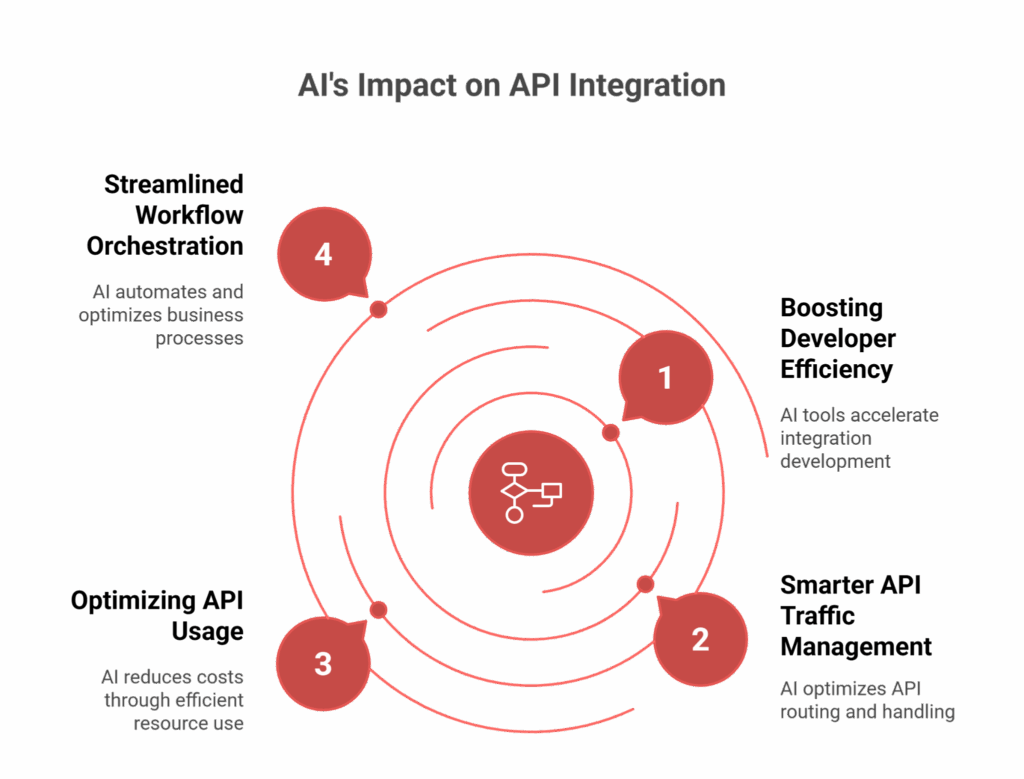
Boosting Developer Efficiency
AI acts as a “co-pilot for integration development,” augmenting human developers and significantly accelerating time-to-value. Generative AI and Natural Language Processing (NLP) capabilities are key, allowing developers to conversationally describe integration requirements in plain English, which the AI then interprets and translates into technical implementations. This enables:
- Automated Integrations: AI suggests integration workflows and generates configurations for flows, reducing the need for developers to manually write every step.
- Smart Data Mapping: AI analyzes data schemas and uses predictive field matching to suggest or automatically implement complex data transformations. This task, traditionally cited as the most time-consuming part of integration, is significantly sped up by AI.
- Conversational Instructions: Natural language flow builders democratize the process, allowing team members with various technical expertise to contribute to the creation of integration flows.
Smarter API Traffic Management
AI overcomes rigid routing limitations by injecting real-time intelligence into traffic management. This capability is essential for managing load and ensuring high availability:
- Dynamic Routing: AI-powered routing analyzes real-time network conditions and system loads to dynamically select the optimal path for API requests, maximizing efficiency and resilience.
- Priority-Based Handling: AI assesses the business context of requests, ensuring that mission-critical transactions are prioritized during periods of high load to guarantee uninterrupted essential operations.
- Predictive Failure Avoidance: Machine learning models detect performance patterns that typically precede system failures and proactively reroute traffic or adjust resource allocation before disruptions impact users.
Optimizing API Usage
The ability of AI-powered integration platforms to analyze usage patterns provides direct, measurable operational cost reductions:
- Intelligent Throttling: Instead of static rate limits, AI dynamically adjusts rate limits based on historical data, current system conditions, and real-time business priorities, ensuring optimal resource allocation.
- Predictive Caching: AI models analyze historical usage to accurately predict which API responses should be cached and for how long, dramatically reducing redundant calls while maintaining data freshness and lowering overall resource consumption.
- Cost Reduction: For organizations relying on usage-based third-party APIs, AI optimization ensures highly efficient data retrieval, significantly reducing unnecessary calls and associated expenses.
Streamlined Workflow Orchestration
Intelligent workflow orchestration uses AI to coordinate complex, multi-step business processes across disparate systems.
- Automated Workflow Composition: AI analyzes business requirements and automatically composes sequences of API calls to achieve specific outcomes, streamlining the design process.
- Adaptive Optimization: Machine learning algorithms continuously monitor workflow execution and refine integration paths based on usage patterns, creating self-learning and self-optimizing workflows.
- Event-Driven Actions: AI identifies meaningful data patterns flowing through APIs and autonomously triggers appropriate workflows in response, enabling more responsive and autonomous business processes.
How AI Harnesses API Data for Smarter Integration
The intelligence that powers the modern AI iPaaS is derived directly from the vast volumes of data collected and processed via the API layer. This process demonstrates how AI in API integration makes the system more adaptive and efficient.
Data Collection through APIs
Integration platforms rely on APIs for continuous data harvesting, which creates a rich foundation for the AI to analyze and learn from. This includes critical metadata that defines the systems and processes:
- Gathering Metadata: AI systems continuously collect API schemas, documentation, and usage statistics (metadata collection) to build comprehensive maps of service capabilities. The transformation logic itself is often defined through metadata such as mappings and business rules which allows the iPaaS engine to automate data processing without hardcoding.
- Monitoring Transactions: By analyzing API request and response patterns, AI gains real-time insight into performance trends, anomalies, and optimization opportunities across the entire integration landscape.
- Integrating Business Context: AI increasingly incorporates business metrics and Key Performance Indicators (KPIs) when analyzing API traffic, enabling technical decisions that align directly with strategic business priorities.
Processing Data with AI
Once collected, this data is processed using sophisticated AI techniques to achieve predictive capabilities:
- Pattern Recognition: Machine learning models analyze historical integration patterns to develop stable integration templates that work across different systems, streamlining future integration projects.
- Anomaly Detection: AI employs techniques like supervised and unsupervised learning to identify subtle deviations from normal behavior by clustering similar transactions and flagging statistical outliers. This is essential for predictive API monitoring, allowing the platform to flag potential security risks or performance issues before they escalate.
- Continuous Learning: The AI models continuously train on new data, refining their logic for predictive error resolution and smart data cleansing. This ongoing process allows the iPaaS to learn and improve its mapping accuracy and operational efficiency over time, leading to increasingly self-healing systems.
This dynamic synergy ensures that the enterprise-grade iPaaS operates not just as a connector, but as a responsive central nervous system, constantly optimizing workflows and adapting to change based on the real-time intelligence derived from its API integration data.
Real Business Impact of AI-Enhanced API Integration
The measurable impact of integrating AI into enterprise-grade iPaaS solutions extends far beyond the IT department, delivering substantial returns for the business.
Cost Reduction in Development and Operations
The most direct financial benefit of AI iPaaS is the reduction of manual labor costs. AI automates repetitive, low-value tasks like documentation and field mapping, freeing up highly compensated specialist personnel.
- Reduced Development Costs: By automating complex integration tasks, organizations can minimize reliance on specialized integration staff, allowing them to focus on higher-level architectural design. AI-assisted automation also significantly shortens project timelines, further reducing overall development costs.
- Operational Savings: AI’s ability to provide predictive API monitoring and failure avoidance significantly reduces downtime and the associated costs of incident response and troubleshooting. Furthermore, optimized API usage through intelligent throttling and caching minimizes unnecessary consumption of third-party API usage and cloud compute resources.
Faster, More Efficient Workflows and Improved Data Utilization
AI enhances productivity by accelerating time-to-market and ensuring data quality:
- Accelerated Time-to-Market: AI enables rapid system integration, reducing implementation timelines for standard integration patterns from potential months to mere days.
- Data Utilization: By guaranteeing access to clean, unified, and real-time data pipelines across multi-cloud environments, the enterprise-grade iPaaS ensures that forecasting models gain comprehensive, cross-functional insights. This clean, multi-source data is non-negotiable for competitive predictive decision-making.
Enhanced Business Agility and Better Customer Experiences
AI-driven API integration efficiency translates directly into market responsiveness and customer satisfaction.
- Increased Agility: The platform’s ability to quickly adjust and deploy new integrations allows businesses to promptly react to changing market conditions or internal priorities. This speed is crucial for maintaining a competitive advantage.
- Measurable Financial Returns: Early adopters of AI are already reporting measurable financial success, achieving an average return of $1.36 for every $1 invested, representing a 136% ROI. This highlights that the AI iPaaS ROI is not merely theoretical but a realized financial benefit.
- Customer Experience: Customer experiences improve through AI-driven omnichannel consistency, ensuring that journey data flows freely across all touchpoints, creating coherent and personalized interactions regardless of the channel.
How BURQ.io Enables AI-Ready API Integration
BURQ.io is engineered as an enterprise-grade iPaaS solution, specifically designed to address the challenges of multi-cloud API integration and autonomous AI adoption through its AI-powered integration platforms. It provides a scalable, AI-ready integration architecture that simplifies complex, high-volume workflows.
BURQ.io brings intelligence into your integrations with features that automate complex governance and development tasks:
- Natural Language Flow Builder: BURQ.io makes integration accessible to everyone with its natural language builder. Simply describe your integration in plain English for example, “Sync new orders from Shopify into Dynamics 365 every hour” and BURQ automatically generates the DataFlow configuration.
- AI-Assisted Mapping: BURQ’s AI engine analyzes data schemas and proposes the most likely matches automatically, simplifying complex transformations by letting AI suggest field mappings. Instead of manually aligning fields across systems, this capability helps teams move faster with fewer errors.
- AI-Based Monitoring & Resolution: BURQ extends monitoring with AI-driven insights that not only detect anomalies (a key component of predictive API monitoring) but also recommend corrective actions. Failed transactions can be automatically classified and flagged with suggested resolutions, significantly reducing manual troubleshooting and improving overall stability.
- AI Agent Orchestration: Easily integrate AI bots and agents into your workflows. Whether it’s an AI chatbot for customer support or an intelligent assistant for supply chain forecasting, BURQ allows you to orchestrate human, system, and AI-driven processes within the same platform. This provides the necessary framework for governing agent behavior and ensuring data grounding for secure, autonomous operations.
By consolidating these features, BURQ.io provides a unified platform that addresses API sprawl management proactively while maximizing development speed.
Conclusion: Preparing for an AI-Driven Integration Future
The shift to AI iPaaS marks a fundamental architectural change for the digital enterprise. AI in API integration is not a feature add-on; it is the core capability that enables systems to be self-healing, self-optimizing, and truly autonomous. The confluence of API sprawl, compliance pressures, and the rising need for complex multi-cloud connectivity has rendered legacy integration strategies obsolete.
For leaders seeking enhanced API integration efficiency, the choice of an enterprise-grade iPaaS is the single most critical decision you will make in your digital roadmap. Adopting an AI iPaaS that offers predictive capabilities and AI agent governance is essential for future-proofing your organization.
To learn how BURQ.io’s AI-ready integration platform can provide the enterprise-grade iPaaS foundation your organization needs to orchestrate the future of autonomous business, connect with our team today for a personalized demonstration.
FAQs
What causes API sprawl in enterprises?
API sprawl happens when teams create endpoints without centralized oversight. BURQ’s AI iPaaS automatically discovers and organizes APIs, giving full visibility. This reduces redundancy and simplifies management.
How does AI improve API integration speed?
AI automates repetitive tasks like data mapping and workflow creation. This minimizes manual coding and accelerates integration projects. Organizations can deploy integrations in days instead of months.
How does BURQ enhance API security?
BURQ detects hidden shadow APIs and applies automated authentication and monitoring. This prevents unauthorized access and helps maintain compliance. It strengthens overall enterprise security posture.
Can AI help reduce API operation costs?
AI optimizes API usage, predicts failures, and dynamically scales resources. This reduces infrastructure costs and avoids downtime. Operations become more efficient and cost-effective.
What makes AI-powered iPaaS better than traditional tools?
AI iPaaS like BURQ offers dynamic routing, predictive monitoring, and self-healing workflows. Legacy middleware cannot adjust in real time or automate complex integrations. AI platforms provide smarter, faster, and more reliable connectivity.
How do you measure AI iPaaS success?
Measure success using metrics like integration speed, downtime reduction, and cost savings. Monitor data accuracy and workflow efficiency across systems. These indicators show real business impact.