

Modern enterprises depend on Integration Platform as a Service (iPaaS) solutions to connect applications, data, and processes across cloud and on-premises environments. But as integration volumes grow, so do the security stakes. In fact, the average cost of a data breach hit an all-time high, $4.88 million recently, and misconfigured integrations can expose sensitive data on a massive scale. With strict regulations like GDPR, and various breaches now involving cloud-stored data, it’s clear that iPaaS security and compliance are not optional, they are mission-critical.
This blog explores why security and compliance matter in iPaaS, what certifications and standards to look for, and best practices to ensure your integrations are both secure and compliant.
Why Security and Compliance in iPaaS Matter?
Security and compliance are paramount in iPaaS because these platforms serve as the data conduits for your entire IT ecosystem. Below are some reasons which indicate the importance of security and compliance in iPaaS
- Breach or Compliance Failure: iPaaS handles customer information, financial records, health data, and other sensitive assets moving between systems. A breach or compliance failure in this integration layer can have cascading consequences, from heavy regulatory fines to reputational damage and business downtime. For example, global data privacy laws like the EU’s GDPR mandate breach notifications and can impose fines up to 4% of global revenue for non-compliance.
- Customers’ Trust: Beyond fines and legal risks, losing customer trust is a major concern. Nearly 46% of breaches expose customers’ personal data, eroding confidence in the business. Business leaders recognize that secure integration is essential for maintaining that trust.
- Challenges In Hybrid Environments: A hybrid integration environment also creates complexity, data can cross multiple clouds and on-prem systems, with different controls, so organizations should understand where their iPaaS partner is storing or processing its data. Security and compliance in iPaaS are therefore the basis of digital trust: it keeps your organization out of the hands of breaches, and it keeps you in compliance with the requirements of laws and standards that regulate your data.
Key Compliance Frameworks and Standards in Integration
To build a compliant integration strategy, it’s important to understand the regulatory frameworks and standards that commonly affect iPaaS usage.
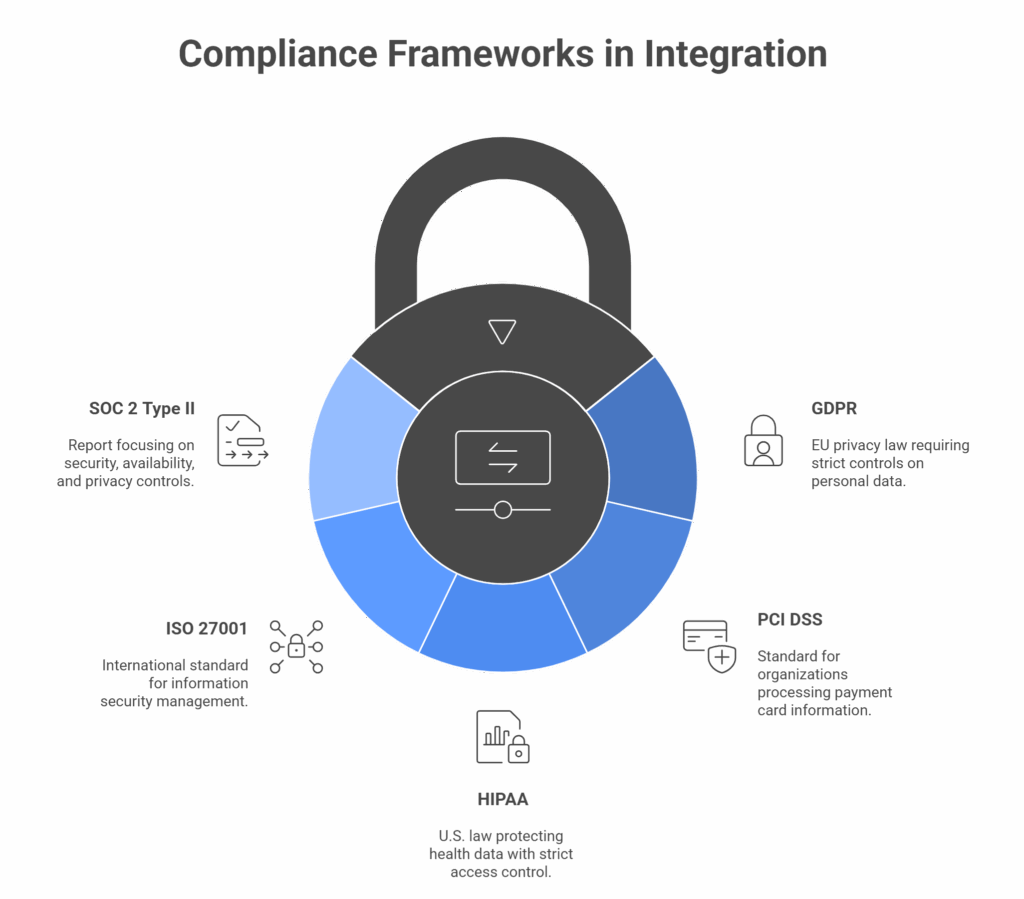
General Data Protection Regulation (GDPR)
A broad EU privacy law requiring strict controls on personal data. GDPR mandates measures like transparency in data use, encryption of personal data, clear user consent, and the “right to be forgotten” (data erasure). Any iPaaS handling EU resident data must support GDPR compliance (e.g. data encryption, breach notification, and data deletion capabilities).
Payment Card Industry Data Security Standard (PCI DSS)
A standard for any organization processing payment card information. PCI DSS requires encryption of cardholder data, strong access controls, secure network architecture, and regular security testing. If you integrate payment systems via iPaaS, the platform should offer features like tokenization (replacing sensitive card numbers with tokens) and robust identity management to meet PCI requirements.
Health Insurance Portability and Accountability Act (HIPAA)
A U.S. law that protects health data. HIPAA mandates strict access control, user authentication, and audit logging for any system handling electronic PHI. Organizations using iPaaS in healthcare should ensure the platform can sign a Business Associate Agreement (BAA) and provides the required safeguards (encryption, audit trails, etc.) for HIPAA compliance.
ISO 27001
The internationally recognized standard for information security management. ISO 27001 certification means the vendor’s security practices (from data handling to access management) have been audited and meet a comprehensive set of controls. An ISO audit evaluates how the company protects data, including secure handling of personally identifiable information (PII). If an iPaaS has ISO 27001 (or related standards like ISO 27017 for cloud security, ISO 27018 for cloud privacy), it indicates a strong baseline of security governance.
SOC 2 Type II
A Service Organization Control report focusing on security, availability, confidentiality, and privacy controls. SOC 2 attestation (Type II in particular) means an independent auditor has assessed the cloud service over time and verified that controls are effectively in place. Many enterprises require a SOC 2 report from SaaS and iPaaS providers to ensure they meet trust principles. SOC 1 (focused on financial reporting controls) may also be relevant if your integrations involve financial data.
Best Practices for iPaaS Security and Compliance
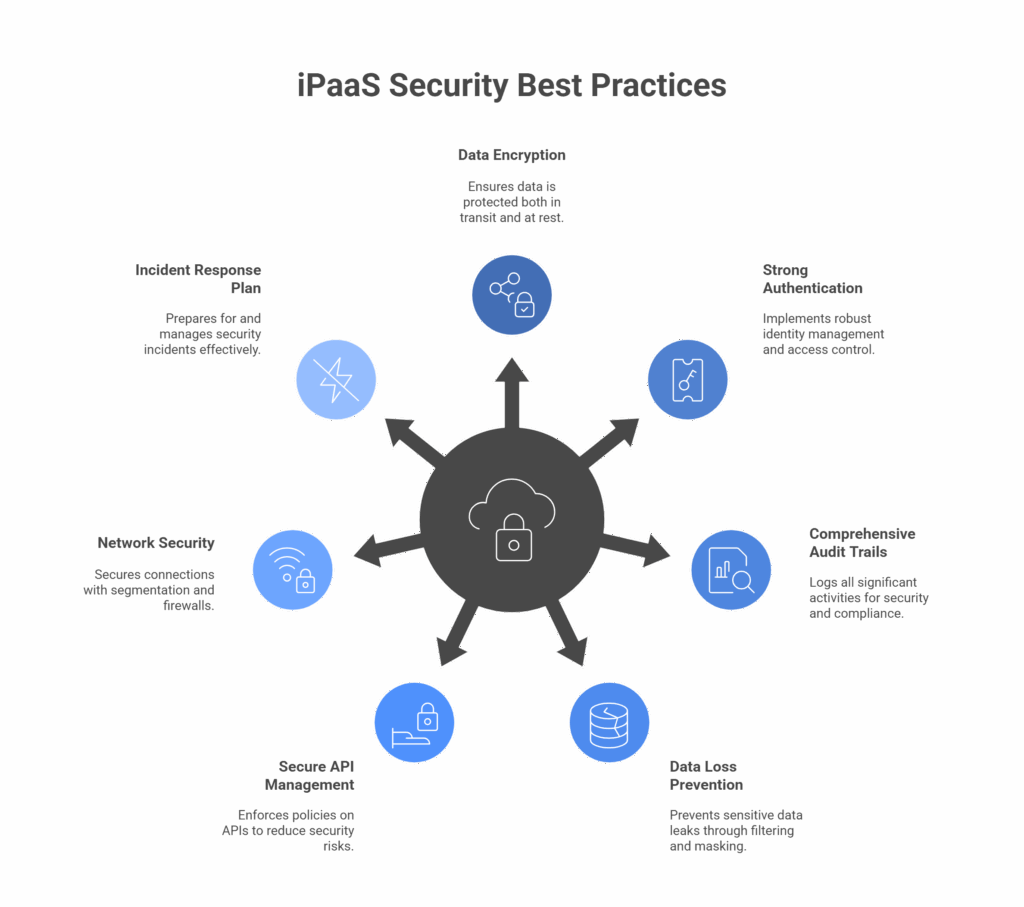
Although it is very important to select a certified vendor, security and compliance is a collective responsibility. Your company needs to make sure that your iPaaS partner is following security best practices as a data processor. Following are the main best practices that should be adopted in your iPaaS environment and integration processes:
Encrypt Data in Transit and at Rest
All information that passes through the iPaaS should be encrypted with a robust protocol. Data in transit encryption TLS (HTTPS) is a compulsion to avoid eavesdropping. Major iPaaS providers support TLS 1.2+ and even enable the use of HSTS (strict transport security) on all connections. Also, ensure that data at rest (including any staging areas, queues or persisted data within the platform) is encrypted, most commonly with AES-256. Some platforms let you bring your own encryption keys or vault – a best practice for sensitive data. End-to-end encryption, where you control keys, provides the highest assurance.
Strong Authentication and Access Control
Use robust identity management for anyone accessing the iPaaS and for any integrated endpoints. Implement Single Sign-On (SSO) and Multi-Factor Authentication (MFA) for the iPaaS user interface to prevent account breaches. Within the platform, leverage Role-Based Access Control (RBAC) to grant users the minimum permissions they need (principle of least privilege). For example, your developers might have access to build integrations, but only admins can promote flows to production or view production data. Many breaches stem from credential abuse; encrypted credentials and API keys should be standard, credentials stored in the iPaaS should be encrypted with unique keys. Regularly review user roles and integrate with your corporate directory for automated de-provisioning when employees leave.
Comprehensive Audit Trails
Your iPaaS should log every significant activity, data transfers, configuration changes, login attempts, and administrative actions. Audit trails are vital for both security and compliance. They enable you to detect unusual access patterns and provide evidence of due diligence during compliance audits. Modern iPaaS solutions often offer built-in logging and even immutable audit logs (sometimes leveraging blockchain for tamper-evidence). Ensure logs capture the “who, what, when, and where” of data access. Also, set up log monitoring and alerts – for instance, alert if a large data export occurs or if an API credential is used from an unfamiliar IP address. Continuous monitoring and centralized logging help identify and close gaps before they become incidents.
Data Loss Prevention (DLP) Policies
Implement DLP rules within your integration processes. This might involve filtering or masking sensitive data fields as they move through the pipeline. Top iPaaS platforms allow pattern-based data masking (e.g., masking credit card numbers or Social Security numbers) and can prevent certain data from leaving a designated region. DLP policies prevent sensitive data leaks, for example, blocking the transfer of customer PII to an unauthorized marketing app. They also help enforce compliance by ensuring, say, that EU citizen data doesn’t get routed to a non-compliant system. If your iPaaS doesn’t have built-in DLP, consider integrating external DLP tools at critical points.
Secure API Management
Integrations often expose APIs or use APIs to connect systems, so applying API security best practices is crucial. Use an API management layer or gateway to enforce policies on all APIs involved in your integrations. This includes rate limiting, input validation, and threat detection. Every API call in the iPaaS should be authenticated and authorized, consider OAuth 2.0 and fine-grained scopes for system integrations. By locking down APIs, you reduce the risk of an attacker exploiting an open endpoint in your integration flow.
Network Security and Segmentation
Treat your iPaaS connections as you would your core network. Use IP allowlists/denylists for inbound connections to integration endpoints when possible. If your iPaaS offers a self-hosted runtime or agent (for hybrid integration), deploy it in a secure network segment, behind firewalls, and connect to the cloud service over VPN or private link. This ensures data in transit between your data center and the iPaaS is not exposed on the open internet. Leverage any virtual private cloud (VPC) or network isolation features the provider offers.
Incident Response Plan
Despite all precautions, incidents can happen. Your iPaaS partner should have defined an incident response plan for integration breaches or failures. Determine how iPaaS will detect anomalies (e.g., via monitoring alerts), who is on the response team, and how to isolate and contain an issue in the iPaaS (for instance, disabling certain connectors or credentials quickly). This plan should address compliance needs too, e.g., if a breach in an integration is detected, how will your iPaaS meet the 72-hour notification requirement of GDPR, or notify affected customers? Being prepared not only minimizes damage but also demonstrates to regulators that you take compliance seriously.
Evaluating an iPaaS Provider’s Security Posture
Before fully entrusting your integration layer to an iPaaS vendor, perform thorough due diligence on their security and compliance posture. Here’s a checklist of evaluation steps:
Examine Certifications and Reports:
As discussed earlier, verify the vendor’s relevant certifications (ISO, SOC 2, PCI, etc.). Don’t hesitate to request their latest audit report or a summary of findings, a trustworthy provider will have these ready.
Review the Trust Center and Documentation:
Most top iPaaS companies maintain a trust center or security webpage detailing their security architecture, data handling practices, and compliance measures. Review this information closely. Pay attention to data flow diagrams (how data moves and where it’s stored), encryption standards used, and how they isolate customer data in a multi-tenant environment.
Inquire About Data Management Policies:
Ask how the provider handles data retention and deletion. For example, if you stop using the service, will your data be purged promptly? How do they sanitize disks or backups containing your data? If GDPR applies, does the vendor support features to delete or anonymize data for data subject requests? Understanding these policies will ensure there are no surprises that could put you out of compliance.
Assess Security Features Against Your Requirements:
Map the platform’s security features to your own security requirements or controls framework. If your policy requires all user activity to be logged, confirm that the iPaaS can provide those logs and integrate them with your SIEM. For organizations that rely on an Identity Provider (Azure AD, Okta, etc.) for single sign-on, check whether the iPaaS supports SAML or OIDC. Strict key management rules may also demand that the vendor offers a bring-your-own-key option or integration with a KMS. Create a checklist of must-haves (encryption, SSO/MFA, RBAC, API security, etc.) and verify each.
Consider Scalability of Compliance:
As your organization grows or regulations evolve, will the iPaaS scale with your compliance needs? Check if they stay up-to-date with new laws, e.g., support for the latest privacy laws or emerging standards. If you operate globally, can they support cross-border data transfer mechanisms? A future-ready iPaaS should demonstrate a roadmap that includes ongoing security enhancements and compliance updates.
Perform a Pilot Security Review:
If possible, run a pilot or proof-of-concept focusing on security. Engage your security team to do a penetration test or vulnerability scan on a non-production instance of the iPaaS environment (many vendors will allow this with permission). This can reveal configuration issues or how well the platform defends against common threats.
Final Thoughts!
Integrating your IT ecosystem with an iPaaS can unlock tremendous agility, but it must be done by implementing security and compliance standards. From encryption and access control to monitoring and certifications, a multi-layered approach will fortify your integration environment.
Our iPaaS platform is built with enterprise-grade security and compliance features at its core, helping your organization integrate applications confidently in a world of evolving regulations. Whether you need to unify data under strict GDPR rules or streamline processes in ISO 27001 compliant way, we can help you navigate the journey. Secure your integrations and accelerate your digital transformation with a trusted partner, visit Burq to learn how we can support your iPaaS security and compliance needs.
FAQs
How does BURQ handle multi-tenant data security?
BURQ iPaaS uses strict logical isolation and encryption to secure data in multi-tenant environments. This ensures that each customer’s information remains protected and inaccessible to other tenants. With enterprise-grade controls, BURQ maintains separation without compromising scalability.
What role does data residency play in BURQ iPaaS compliance?
Data residency is critical for meeting laws like GDPR. BURQ provides transparency into where data is stored and processed to help enterprises comply with local residency requirements. This makes it easier for global businesses to stay compliant.
Can BURQ integrate with existing enterprise security tools?
Yes. BURQ iPaaS integrates seamlessly with leading enterprise security solutions, including identity providers (Okta, Azure AD), key management services, and SIEM tools. This ensures organizations can enforce their existing security controls and gain centralized visibility across all integrations.
How does BURQ support incident detection and response?
BURQ offers built-in monitoring, anomaly detection, and real-time alerting to quickly identify suspicious activities. In the event of an incident, BURQ enables rapid credential revocation and isolation of affected integrations, helping organizations meet compliance obligations like GDPR’s 72-hour breach notification rule.
Are there risks with shadow integrations in BURQ?
Shadow integrations, those built outside IT oversight, pose risks in any iPaaS environment. BURQ addresses this with strong governance features, role-based access control, and approval workflows, ensuring that only authorized and compliant integrations are deployed.