

For too long, error handling in enterprise integration environments has been a manual, reactive, and extraordinarily expensive process. Traditional systems often rely on human intervention to triage symptoms long after a catastrophic failure has occurred. Modern enterprises, particularly those moving decisively toward digital transformation and AI adoption, are now facing the reality that manual processes are no longer viable. The sheer volume and complexity of data flowing through the modern ecosystem, driven by an increased mandate to integrate artificial intelligence (AI) across core business functions, require a foundational shift in operational resilience.
This blog uncovers how integration runtime errors evolve into enterprise-wide risk, and how AI-driven iPaaS platforms are redefining resilience through predictive error handling.
The Strategic Burden: Translating Integration Run-time Errors into Enterprise Risk
The fragility of enterprise integration systems represents a massive, quantifiable financial risk that must be addressed at the executive level. Integration failures must be viewed not just as technical hiccups but as direct threats to financial stability and strategic goal attainment.
The Financial Impact of Downtime
Integration failures are immediately and acutely expensive. According to ITIC data, 97% of large enterprises report that, on average, a single hour of downtime costs their company over $100,000. When considering system resilience across the calendar year, the median annual downtime across all business impact levels reaches 77 hours, approaching three full days of lost efficiency. This calculation alone justifies the investment in predictive Automated Error Resolution, positioning advanced iPaaS error handling as a strategic financial hedge against known, catastrophic risk.
The Invisible Cost: Undermining Credibility and Forecasts
Beyond the immediate financial losses, integration failures trigger a deeper credibility crisis within the enterprise. When data silos emerge, often from failed or inconsistent data transmission, they block unified, real-time insights and generate misleading signals instead of reliable intelligence. This fragmentation carries a heavy business cost.
For instance, when a healthcare provider’s patient data synchronization fails between their EHR system and billing platform, it creates discrepancies that cascade through financial forecasting, compliance reporting, and operational dashboards. Executive decisions based on incomplete data, whether about capacity planning, revenue projections, or resource allocation, become fundamentally unreliable.
Modern integration strategies now rely on AI-driven error detection and self-healing mechanisms to identify anomalies, resolve transmission gaps, and restore data continuity before they impact decision-making. For executives, active involvement in such intelligent integration frameworks is crucial to capturing cost and revenue synergies. In this sense, AI-enabled resilience is becoming a cornerstone of effective executive governance.
Anatomy of Run-time Failure and Data Loss
Integration run-time errors are complex and cumulative, often beginning with seemingly small issues that cascade into catastrophic data loss and operational failure. These errors can be categorized based on their technical root, all of which directly expose the organization to significant financial and compliance penalties.
- Resource Constraints and Timeouts: These often manifest as pipeline timeouts, system-wide failures, or jobs getting stuck in a queue. A common example includes “Out of memory” errors when processing large datasets, such as attempting to load a 2GB CSV file into a runtime with 1GB memory limits, causing the entire integration pipeline to fail and potentially losing hours of transaction data.
- Connectivity and Authentication Failures: Integration processes rely on continuous, validated connectivity. Failures here include unexpected connection closures or access issues, such as when calling services where multi-factor authentication is configured but the integration connector lacks proper OAuth refresh token handling, leading to silent authentication failures and data sync gaps.
- Data Integrity and Transformation Errors: These failures occur when the data itself is faulty or unexpected. Examples include anomalous input or output sizes, unexpected transformations, or schema drifts. Real-world example: A SaaS vendor changes their customer API response from phone_number to primary_phone without notice, breaking field mappings and causing thousands of customer records to be written with null phone values, corrupting downstream marketing automation and support ticketing systems.These integrity errors poison downstream systems, corrupting data lakes and undermining the reliability of every connected process.
The New Era of AI Error Management: From Triage to Predictive Defense
The challenges inherent in traditional error management, manual intervention, escalating costs, and reliance on static rule-based systems have become insurmountable barriers in an era of rapid digital acceleration. The constraints are clear: legacy approaches cannot scale to meet the velocity and complexity of modern data ecosystems. The next generation of enterprise resilience, powered by Machine Learning (ML), mandates a systemic shift from manually processing symptoms to predicting and preventing the root cause of error.
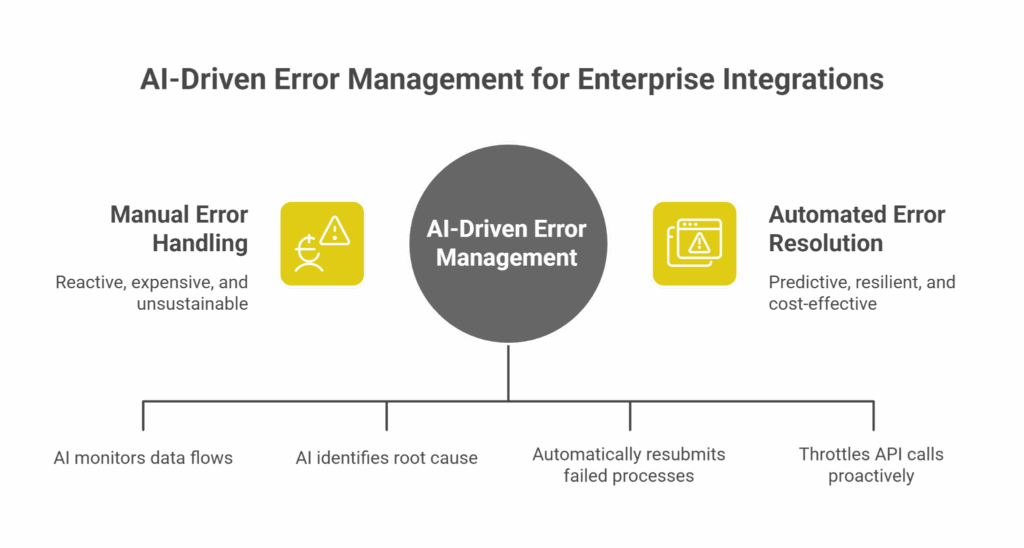
The Shift from Legacy to Intelligent Platforms
Traditional error management often required developers to manually build, update mapping logic, schedules, and complex error rules .Legacy systems relied on static rule-based databases or preconfigured workflows, which limited scalability and adaptability, resulting in high infrastructure costs and output relevance that decreased over time, often requiring significant manual curation.
The modern iPaaS leverages advanced AI and ML models to overcome these constraints. This shift incorporates machine learning models including random forests for pattern recognition and LSTM (Long Short-Term Memory) networks for time-series anomaly detection, alongside generative AI and advanced retrieval methods to enhance troubleshooting, moving the platform’s core capability to pre-emptive prediction and remediation.
Proactive Defense: Anomaly Detection and Predictive Analytics
The primary mechanism for predictive defense is the integration of AI algorithms that continuously monitor data flows and performance metrics.
- AI-Powered Anomaly Detection: AI analyzes historical metrics, including integration latency, run-time failure rates, and transaction volume. By establishing baseline behavioral patterns over rolling 30-day windows, the system instantly identifies data spikes, schema drifts, or unusual error patterns that signal an impending failure before it manifests as a hard outage. For example, if API response times that normally average 200ms suddenly spike to 1,800ms, the system can alert operations teams 15-20 minutes before timeout thresholds are breached, allowing proactive intervention. This preemptive alerting capability is critical for maintaining operational continuity.
- Continuous Learning and Refinement: AI-driven data mapping automatically analyzes schemas and suggests field mappings, minimizing manual effort. Critically, the AI refines these transformations and error-fixing suggestions over time by utilizing feedback loops gathered from the results of previous integration attempts. For complex datasets involving nested JSON structures or dynamically typed fields, advanced ML architectures such as transformer-based models provide the adaptability necessary to handle diverse schema and transformation scenarios, ensuring consistent and accurate data flow even in complex, multi-source environments.
- Intelligent Root Cause Analysis (RCA): When an incident does occur, an AI-powered RCA system dramatically accelerates resolution. Instead of merely reporting a symptom (such as “pipeline timed out”), the system processes vast amounts of data in real-time, identifying complex patterns and correlations across disparate logs and linked systems to pinpoint the true, underlying cause. Industry implementations have demonstrated up to 50-60% reduction in mean time to resolution (MTTR) compared to manual diagnosis methods This capability fundamentally transforms IT teams from reactive fire-fighters into proactive risk management partners.
Automated Resolution: Operationalizing Resilience and Guaranteed Data Delivery
Achieving truly resilient integration means ensuring that when transient issues arise, the system automatically corrects and recovers without human intervention or data loss. Automated Error Resolution is the strategic application of AI features to guarantee data flow and manage external resource consumption.
Guaranteed Recovery: Adaptive Retry Logic
Transient errors, those caused by network jitters, temporary API server blips, or momentary resource contention should never lead to data loss or halt critical business processes. Automatic Retries are an essential function for guaranteed recovery.
However, simple retries are insufficient. High-resilience platforms like Burq iPaaS implement adaptive logic, most effectively through exponential backoff combined with random jitter. This strategic approach ensures that if the first retry fails, subsequent attempts are spaced out increasingly (exponentially), preventing the application from overwhelming the receiving server or falling into an endless, costly retry loop. This mechanism ensures data delivery while simultaneously preventing resource waste and managing server load, thereby enhancing system stability and cost efficiency.
Strategic Cost Control: Proactive Rate Limiting
Managing cloud consumption and adhering to external API vendor limits is a significant strategic imperative. Without sophisticated controls, an integration spike can result in sudden throttling, massive downtime, and unexpected financial penalties. Intelligent systems must incorporate features for Proactive Rate Limiting.
Burq tracks real-time rate limits (often reading headers like X-RateLimit-Remaining provided by external APIs) and proactively throttle API calls before the hard limits are reached. This feature acts as an executive safeguard, preventing unexpected blocks, mitigating costly overages, and maintaining governance standards with vendor API consumption policies, a critical function for managing operational expenditure.
Self-Healing Workflows and Optimization
AI Error Management is designed not only to fix problems but also to continuously optimize the integration ecosystem.
- Predictive Routing: Based on analysis of historical latency and failure rates, the AI selects the optimal data paths in real time to minimize processing delays and maintain flow velocity. For multi-region deployments, this means automatically routing traffic away from degraded endpoints toward healthy alternatives before users experience impact.
- Smart Data Cleansing: Machine Learning algorithms are deployed to detect anomalies in the data payload and automatically correct or flag dirty data before it can corrupt critical downstream systems, thereby protecting the integrity of the organization’s AI-ready data foundation.
- Dynamic Resource Allocation: By leveraging historical demand forecasting and failure predictability, the iPaaS platform can dynamically scale compute nodes up or down in real time. This turns error management into cost-effective performance optimization, ensuring capacity is always available during peak load while minimizing waste during quiet periods.
Adherence to Compliance Standards
Equally important, AI-driven error management in iPaaS enhances auditability and compliance posture. For organizations subject to SOC 2 requirements, complete audit trails of every retry attempt, data transformation, and system decision ensure the logging and monitoring controls necessary for Type II attestation. For GDPR compliance, automated tracking of data flows enables rapid response to data subject access requests (DSARs) by maintaining lineage of personal data across all integrated systems. ISO 27001 information security management benefits from immutable logs and automated incident detection that support continuous monitoring requirements
The following table summarizes how core AI capabilities translate into measurable business outcomes.
| AI Error Management in iPaaS and its Business Impact | |||
| AI Capability | Technical Function | Primary Strategic Outcome | Impact Metric |
| Anomaly Detection | Identifies unusual patterns (volume/duration) signaling impending failure. | Predictive defense; prevents downstream system corruption. | Reduced unplanned outages. |
| Intelligent RCA | Correlates cross-system data to pinpoint the true root cause, not just the symptom. | Faster MTTR (Mean Time To Resolution). | Up to 5-60% reduction in diagnosis time. |
| Adaptive Retry Logic | Automatically resubmits failed processes using exponential backoff. | Guaranteed data delivery; maximizes system uptime. | Reduced lost transactions/data loss. |
| Proactive Rate Limiting | Uses real-time API feedback to throttle calls before contractual limits are hit. | Cost control; maintains compliance and vendor relations. | Reduced throttling penalties/API overage costs. |
Key Takeaways for Enterprise Leaders
The transition from reactive to predictive error management represents a fundamental shift in integration strategy:
- Financial Justification: With downtime costs exceeding $100,000 per hour for most enterprises, AI-driven error prevention delivers ROI within months, not years.
- Data Integrity as Foundation: In an era where AI and analytics drive competitive advantage, ensuring clean, reliable data flows is not operational, it’s strategic.
- Scalability Without Linear Cost Growth: AI automation enables integration ecosystems to handle 10x data volume increases without proportional increases in support staff or infrastructure costs.
- Compliance as Enabler: Automated audit trails and data lineage tracking transform compliance from a burden into a competitive differentiator, particularly in regulated industries.
- Continuous Improvement: Unlike static systems that degrade over time, ML-powered platforms become more accurate and efficient with each incident they process.
Looking forward, the organizations that will thrive are those that view integration resilience not as a technical problem to be solved, but as a strategic capability to be cultivated. The question is no longer whether to adopt AI-driven error management, but how quickly you can implement it before integration fragility becomes a competitive liability.
Final Thoughts!
AI-driven error management marks a pivotal shift in enterprise integration, turning reactive fixes into intelligent, predictive defense. With machine learning–powered anomaly detection and automated recovery, organizations can ensure data reliability, uptime, and operational trust. In this new era of integration resilience, Burq empowers enterprises to secure every data flow and sustain performance under pressure.
To see how these capabilities can transform your integration architecture, explore Burq Enterprise and schedule a technical demo to discuss your specific integration challenges and resilience requirements.
FAQs
Q1. How does AI-based error handling actually reduce downtime in enterprise integrations?
AI proactively detects anomalies before they escalate into failures. By using predictive models to forecast issues and trigger automated resolutions, platforms like Burq minimize downtime and ensure continuous data flow across systems.
Q2. How can we justify investment in advanced integration error-handling (rather than just more monitoring dashboards)?
The cost of downtime, data loss, and misinformed decisions easily runs into hundreds of thousands per hour. Investing in predictive error detection, automated recovery, and self-healing ensures resilience, not just visibility.
Q3. In large enterprises with legacy systems, how do you prevent authentication or connectivity issues from derailing data flows?
It’s critical to integrate adaptive logic: routine MFA/token-refresh mechanisms, retry logic with backoff, and SLA-linked alerts. Burq’s adaptive retry and proactive monitoring ensure smooth data transfer even under fluctuating network conditions.
Q4. What practical role can ML or deep learning play in schema-mapping and transformation in integrations?
ML can learn from historical mappings, detect schema drifts, suggest field mappings, flag anomalies, and adapt over time. For high-volume, heterogeneous data, advanced models deliver scalability far beyond hand-coded rules.
Q5. When something fails in a pipeline, how can we go beyond “job failed” alerts to actually identifying the root cause fast?
By correlating latency, throughput, error rates, and logs, AI-driven RCA pinpoints the actual cause, not just the symptom. Burq’s intelligent RCA module accelerates diagnosis and resolution, turning IT teams into proactive problem-solvers.
Q6. How does robust error handling tie into compliance, audit, and governance in a regulated enterprise?
Error management isn’t just technical, complete traceability of retries, transformations, and anomalies supports frameworks like SOC, GDPR, or ISO 27001. Platforms such as Burq automate compliance logging, ensuring secure and auditable integrations.