

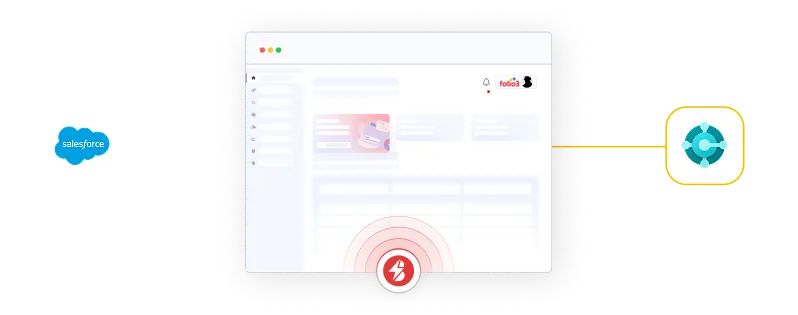
Most Salesforce Business Central integration tools sell speed. Speed means nothing if you are accelerating unprofitable deals. Burq turns live cost and inventory realities inside Microsoft Dynamics 365 Business Central into quoting boundaries inside Salesforce, so reps close faster and profitably.















In mid-market manufacturing, distribution, and services, a rep quoting out of an isolated Salesforce instance gives discounts and promises timelines that quietly decimate the actual margins sitting inside Business Central. A standard Business Central Salesforce integration syncs the record after the damage is done. It does not stop the damage.
Reps optimize for closed-won. Without ERP truth, every quote is a guess.
Discounts approved against last quarter's costs
Delivery dates promised with no view of real inventory
Pricing that looks healthy on the opportunity, thin on the invoice
Finance finds the erosion weeks later, in the close
The true cost picture lives here, and it changes daily. Reps never see it.
Inventory cost shifts with every receipt and revaluation
Supplier price changes ripple into landed cost
Resource and overhead rates move the real services margin
None of it reaches the rep before they commit a price


The same Salesforce Business Central integration reads differently to each team. It removes a different daily friction for all three.
Reps see the discount ceiling at quote time and self-approve anything above the floor. No more guessing, no more waiting on finance for a yes.

The floor finance sets in Business Central is the floor sales quotes against. The argument about a thin deal happens before it is sent, not after it is booked.

Live inventory and item data from Business Central reach reps before they commit a delivery timeline, so operations is not left absorbing promises it never agreed to.

Burq is built Microsoft-first by a Microsoft Solutions Partner and sells the same connectivity as a direct protector of profitability.
Burq is built around the Microsoft data estate. If you run Dynamics 365 Sales alongside Business Central, the same platform handles Microsoft Dataverse integration natively, so your Salesforce Dynamics 365 integration and your Business Central layer share one backbone.
Other tools stop at two-way sync. Burq adds the layer above it: cost-aware quoting boundaries that turn the integration into a guardrail for your gross margin and EBITDA.
Cost and inventory signals can stream in near real time so the margin floor reflects current Business Central reality, while heavier records run on schedule. You decide which flows are live and which batch.
Make the margin floor a soft warning reps can see, or a hard gate that blocks sub-floor quotes until finance approves. Sales keeps selling, finance keeps control.
See how a US home furnishings brand unified direct-to-consumer and eight marketplaces on Microsoft Dynamics 365 Business Central with BURQ iPaaS.
Burq iPaaS is built by Folio3, a Microsoft Solutions Partner with a dedicated Dynamics 365 and Business Central practice. The connector ships with prebuilt Salesforce and Business Central flows, and a team that has implemented the Microsoft stack stands behind it.
A practice built around Dynamics 365, Business Central, Power Platform, and the Microsoft Dataverse, not a generic iPaaS that treats Microsoft as one more endpoint.
Start from tested Salesforce and Business Central templates, then map custom objects and your own margin rules without a heavy rebuild.
Sized for manufacturing, distribution, and services teams that feel margin erosion most and have the least room to absorb it.


Real Results, Real Impact

A European-based retailer automated its Amazon to Business Central integration in two months using BURQ iPaaS — achieving real-time sync across products, pricing, inventory, orders, and shipments with no manual intervention.

A US-based home furnishings company unified eight marketplace channels with Dynamics 365 Business Central through BURQ iPaaS, eliminating manual order management and achieving synchronized inventory across all platforms.

A global footwear brand integrated Shopify, Dynamics NAV, and a third-party logistics provider into a single automated flow using BURQ iPaaS — synchronizing orders, inventory, and fulfillment data across all three systems.

A US event supplies manufacturer automated Amazon order processing, settlement reconciliation, and returns management through BURQ iPaaS — recovering 40 to 50 finance working days per year previously spent on manual data handling.
A standard connector moves accounts, orders, and invoices both ways. Useful, but it acts after a price is committed. Burq adds a layer on top of that sync: cost and pricing realities from Business Central become the discount and quoting boundaries reps see inside Salesforce, before they send the quote. The sync protects profitability, not only data accuracy.
No. The floor is visible at quote time, and any quote below it routes to margin approval instead of being blocked outright. You choose whether the floor is advisory or enforced. Reps keep their speed. Finance stops losing the argument after the fact.
It simplifies them. Burq is Microsoft-first and handles Microsoft Dataverse integration natively, so a Salesforce Dynamics 365 integration and your Business Central margin layer run on one platform rather than two stitched-together tools.
Both, by flow. Cost and inventory signals can stream in near real time so the margin floor always reflects current Business Central reality, while heavier records like invoices can run on a schedule. You set the cadence per object.
Those platforms are competent at quote-to-cash automation and sell it as a time saver. Burq delivers the same Business Central integration with Salesforce, but it is built Microsoft-first by a Microsoft Solutions Partner and positioned as margin defense. Same pipe, a different job: protecting EBITDA, not just saving IT hours.
Yes. Burq maps standard and custom objects on both sides, including CPQ pricing structures, so the margin floor applies to the way your team actually quotes rather than a stripped-down default.
Get in touch for more information and clarifications
